

 Facebook
 X
 Pinterest
 Copy Link
In a November 4 conversation with Tom Ferry, David Childers challenged the comparison between today’s housing market and 2008. It’s worth asking what’s different in the Los Angeles housing market, especially if you’re deciding whether to buy now or wait for prices to fall.
Looking toward 2028, I think a broad collapse is highly unlikely given how much equity homeowners have today. Even a modest drop in price or mortgage rates could make waiting worthwhile. The question is how much would need to change for the home you want to fit your budget.
Homeowner equity in the Los Angeles housing market and the 2008 comparison
Childers’s point about equity is the one I’d focus on. Equity is the difference between what a home is worth and what the owner owes on it. The more room an owner has between those two numbers, the more options they may have if prices fall or they need to sell.
Before the crash, some lenders approved stated income loans without verifying what borrowers earned. Some buyers also borrowed close to the full value of the home. Those were two separate risks. Weak income checks made it easier to take on a payment a household couldn’t sustain. A small down payment left little room for prices to fall. When values dropped, more owners owed more than their homes were worth. As a result, a sale could leave them short of what they needed to pay off the loan, just as refinancing became harder to get.
How much equity did owners have then and now?
By the end of 2008, First American CoreLogic estimated that about 20% of U.S. homes with a mortgage were underwater. Another roughly 5% were close to that point, with equity of about 5% of the home’s value or less. In the second quarter of 2026, Cotality put the national underwater share at 2.1%. In addition, ATTOM found that 41.1% of U.S. homes with a mortgage had at least 50% equity in that quarter.
For example, consider a $1 million home. If the owner owes $950,000 and the home loses 10% of its value, they owe $50,000 more than the home is worth. By comparison, if the owner owes $400,000, the same decline leaves $500,000 in equity before selling costs. That second owner has more room to sell and pay off the loan if a move becomes necessary.
How lending rules and foreclosures changed
Today, federal rules generally require lenders to verify and consider a borrower’s finances and assess whether the borrower can repay the loan. That addresses one weakness of the old lending market. The equity people hold today also reflects changes in home values and how much debt they’ve paid down over time.
Mortgage distress also shows how conditions have changed. In the Mortgage Bankers Association’s national survey, 2.75% of loans were in foreclosure in Q2 2008, compared with 0.67% in Q2 2026. When many owners have little equity and fall behind on payments at once, foreclosures can add to the supply of homes for sale and put more pressure on prices. With fewer owners underwater and fewer loans in foreclosure today, there’s less evidence of that kind of pressure building across the market.
Individual Los Angeles homes can still lose value, especially where buyers have plenty of similar choices or a property needs costly work. However, if your plan is to wait until comparable homes across Los Angeles sell for 50% to 60% below today’s values, I think that outcome is highly unlikely given the equity and foreclosure data we have today. For buyers, that brings the decision down to two numbers you can test today. What price could you negotiate on a home you’d actually buy, and what would the full monthly cost be? From there, you can work out how much prices or rates would need to fall to make waiting worthwhile.
What more listings mean for Los Angeles buyers and sellers
In October 2026, Realtor.com counted 9.9% more active listings in the Los Angeles metro area than a year earlier. Yet new listings fell 6.2%, and median time on market held at 57 days. Buyers had more homes to browse overall, even as fewer fresh choices came onto the market.
For a West Hollywood condo, I’d start with other units in the same building, then look at nearby buildings with similar dues and amenities. For example, when one close match cuts its price and another goes into escrow, I’d look at what each offers for the money. Sellers can use the same evidence. If similar units go into escrow while yours gets few tours, check what buyers can get at your price before deciding whether to adjust it.
What if Los Angeles home prices and mortgage rates fall?
Freddie Mac’s national average for a 30 year fixed mortgage was 7.18% on November 5, 2026. Suppose you’re looking at a $1 million home with 20% down and a 30 year fixed loan. Here’s how the payment changes if the rate, the price, or both move.
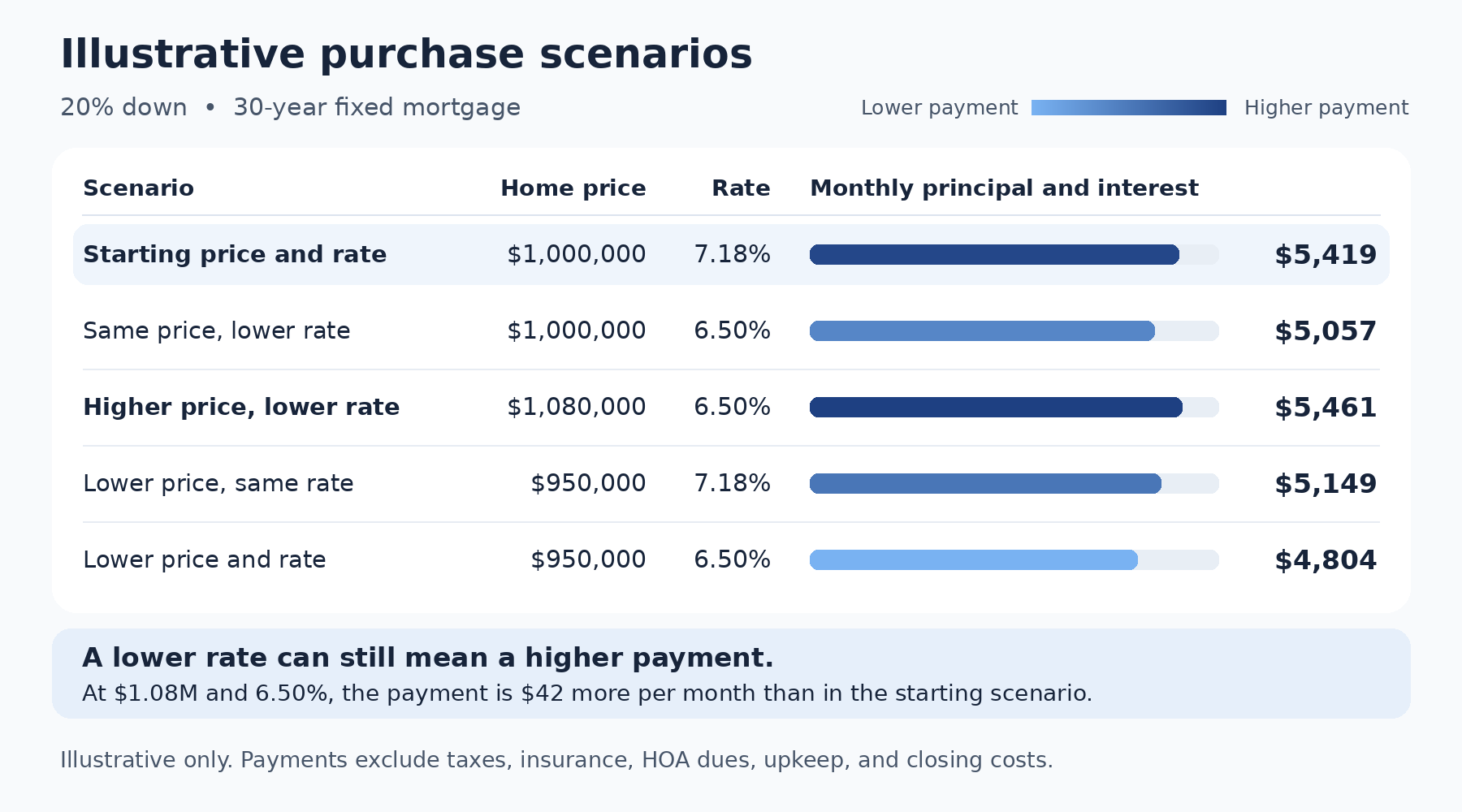
The rates and prices in the waiting scenarios are hypothetical. Payments exclude property taxes, insurance, HOA dues, upkeep, and closing costs. Ask your lender to run the numbers for the home and loan you’re considering.
At the same price, the lower rate saves about $363 a month. But if the price rises 8%, the lower rate leaves you paying about $42 more a month and putting $16,000 more down. On the other hand, if the price falls 5% while the rate stays the same, the payment drops about $271 a month. With both a price drop to $950,000 and a rate drop to 6.50%, the payment drops about $616 a month and you’d put $10,000 less down. These differences use the unrounded payments. If $5,000 is your ceiling for principal and interest, the lower rate alone still leaves you above it. Getting both the lower price and rate brings you below it.
What does another year of renting cost?
Next, compare the cost of renting for another year with the cost of owning. At $3,500 a month, a year of rent costs $42,000. In the $1 million purchase example at 7.18%, the first year includes about $57,200 in interest and $7,850 in principal paid down. Add taxes, insurance, upkeep, and any HOA dues to the ownership side. Also consider what you could save or earn on the down payment while renting. The result will depend on what you pay now and how long you plan to stay.
How the mortgage interest deduction can change the math
Before comparing that year of rent with a year of owning, I’d run the numbers after taxes. If you itemize on your federal return, you may be able to deduct qualifying mortgage interest. A deduction reduces taxable income. The amount you save depends on how much itemizing improves on the deduction you’d take if you kept renting, and on your tax rate.
For a new purchase, the federal deduction generally covers interest on up to $750,000 of qualifying mortgage debt, or $375,000 if married filing separately. Our $1 million example starts with an $800,000 loan, so the limit matters. For 2026, the federal standard deduction is $32,200 for most married couples filing jointly and $16,100 for most single filers. California applies different rules, so ask your tax preparer to run both returns.
A tax example for the $1 million purchase
For example, take the same $1 million purchase. With 20% down and a 30 year fixed loan at 7.18%, you’d pay about $57,200 in interest over the first 12 payments. Applying the $750,000 limit to the loan’s average balance, roughly $53,900 of that interest could qualify as a federal deduction in this example.
Suppose a married couple filing jointly has $280,000 in adjusted gross income and takes the $32,200 standard deduction while renting. Using 2026 rules and assuming a full tax year of payments and no other itemized deductions, here’s what changes.
- Keep renting. Take the $32,200 standard deduction and report $247,800 in taxable income.
- Buy and itemize. Deduct about $53,900 in qualifying mortgage interest and report about $226,100 in taxable income.
Buying would reduce taxable income by about $21,700 more in this example. That difference falls within the 24% federal bracket, for about $5,200 in federal tax savings, or roughly $430 a month spread over a year. A purchase late in the year would generally mean fewer interest payments to deduct on that year’s return. You still need to budget for the full mortgage payment each month.
How to compare your own costs after taxes
Use your actual rent, the home’s full ownership costs, and the tax savings your preparer estimates. Include the costs of buying and selling over the time you expect to stay, and consider what your down payment could earn if you kept renting. If you’d also qualify for a deduction after buying later, count it in that scenario too. So if the after tax comparison favors buying now and the rest of the numbers work, that gives you one more reason to consider the home in front of you.
When buying now makes sense
I’d feel comfortable moving ahead when the home fits your plans, recent comparable sales support the price, and you can carry the full payment while keeping cash for repairs or an income interruption. If the payment only works after a future refinance, I’d wait or look in a lower price range. For a cash purchase, I’d ask how much money you want to keep available after closing and any work the home needs.
Then there’s the home itself. No home is 100% perfect. If you love about 90% of a house or condo that’s hard to replace, I’d ask what’s in the other 10%. Paint or a dated light fixture might be easy to live with or change. Street noise, a layout you can’t work with, or HOA costs that strain your budget deserve more weight. If the home gets the important things right, the tradeoffs are ones you can live with, and the after tax numbers favor buying now, I’d feel comfortable moving forward without waiting for a perfect home or a perfect rate.
If you’re weighing a move, let’s put today’s asking prices and lender quotes next to the price and payment you’d need to see before buying. A home that fits your plans and your budget gives you room to negotiate. Otherwise, you’ll know what to watch for while you wait.
Quick answers
Should I talk to a lender before looking at homes?
Yes. If you need financing, speak with a lender before you start touring. Ask what purchase price range you could qualify for based on your down payment, then tell the lender what you’d feel comfortable paying each month. Have them show you which price range fits that budget once you include property taxes, insurance, any mortgage insurance, and HOA dues. Use that range to guide your search.
Could Los Angeles home prices fall even with fewer foreclosures than in 2008?
Yes. Prices can soften if buyers pull back or similar homes build up in a neighborhood. Recent sales and pending activity can help you judge the price range you’re shopping in.
What should I track if I’m waiting to buy?
Pick a comfortable monthly cost and a minimum cash reserve. Recheck both using actual listings and a fresh lender quote when prices or rates change.
Sources and related reading
CFPB guidance on mortgage preapproval and estimating your monthly housing budget
IRS Publication 936, Home Mortgage Interest Deduction and IRS, 2026 standard deduction amounts
California Franchise Tax Board, Schedule CA instructions, home mortgage interest
The Tom Ferry Podcast Experience, episode 345 with David Childers, November 4, 2026 and Tom Ferry’s official episode notes
U.S. Government Accountability Office, Figure 1, historical MBA foreclosure data and Mortgage Bankers Association, second quarter 2026 National Delinquency Survey
Federal Reserve History, Subprime Mortgage Crisis and Consumer Financial Protection Bureau, ability to repay rule
HousingWire, March 2009 coverage of First American CoreLogic’s year end 2008 equity figures
Cotality, second quarter 2026 Homeowner Equity Insights and ATTOM, second quarter 2026 share of homes with at least 50% equity
Realtor.com, October 2026 Los Angeles metro report, published November 9
Freddie Mac Primary Mortgage Market Survey archive, November 5, 2026
Will Los Angeles Home Prices Drop in 2026? and Home Pricing Strategy: Sell Smarter in Today’s Los Angeles Market
