

 Facebook
 X
X
 Pinterest
 Copy Link
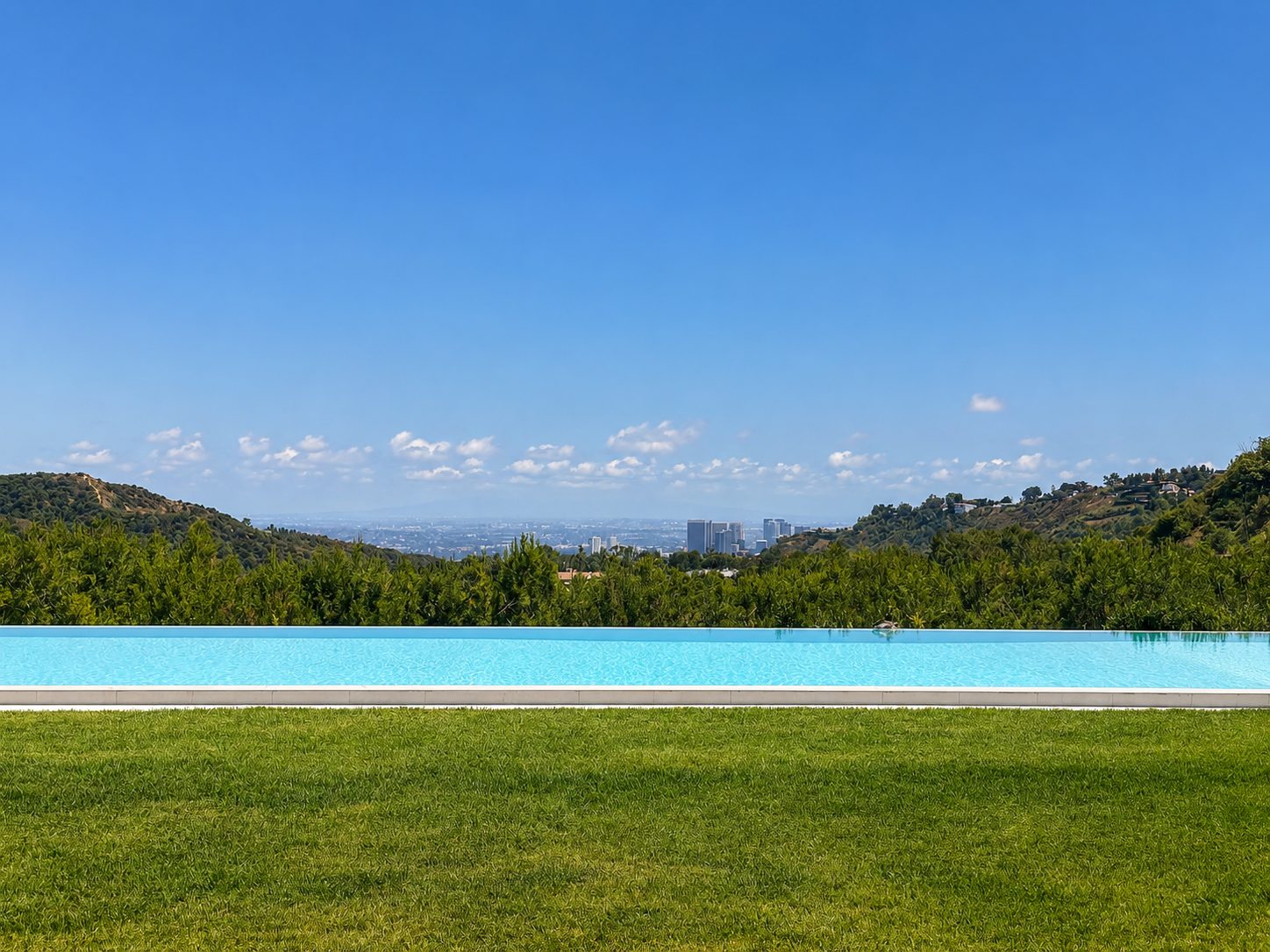
Sweeping city views from a private estate in North Beverly Park, one of Beverly Hills’ most prestigious gated communities.
Why Wealthy Buyers Think Differently About Beverly Hills Real Estate
Luxury real estate is one of the few markets where two buyers can tour the same property, receive the same disclosures, review the same comparable sales, and walk away with entirely different conclusions.
One sees an expensive house.
The other sees an irreplaceable asset.
That difference has very little to do with wealth.
It has everything to do with perspective.
After years advising buyers across Beverly Hills, Bel Air, Brentwood, Santa Monica, Malibu, West Hollywood, and the Westside, I’ve noticed that the most successful purchasers rarely begin by asking whether now is the perfect time to buy.
Instead, they ask whether the property itself is exceptional.
It’s a subtle distinction, but it changes every decision that follows.
Markets move in cycles.
Interest rates fluctuate.
Buyer confidence rises and falls.
Yet genuinely remarkable homes appear only occasionally.
When they do, sophisticated buyers evaluate them very differently than the average consumer.
They’re less interested in predicting what will happen over the next six months and far more interested in what the property could represent over the next twenty years.
That mindset is one of the reasons extraordinary real estate often changes hands quietly, long before the broader market realizes its value.
The Myth of Timing the Perfect Market
One of the most common questions I hear is:
“Should I wait?”
It’s a reasonable question.
Financial headlines encourage us to believe that every purchase can be optimized if we simply wait for the right economic indicator, the next Federal Reserve meeting, or the perfect interest rate.
Luxury real estate rarely works that way.
Some of Beverly Hills’ most iconic estates have sold during recessions.
Others have traded during periods of rapidly rising interest rates.
Some of the strongest long term investments were purchased precisely when uncertainty caused everyone else to hesitate.
Successful buyers understand that markets create opportunities, but opportunities are ultimately created by individual properties rather than market averages.
Two homes listed at the same price can represent dramatically different investments depending on their architecture, location, privacy, views, floor plan, construction quality, and future desirability.
That is why understanding the property almost always matters more than trying to predict the market.
Interestingly, the latest Los Angeles County Housing Report suggests the market is transitioning into a more balanced summer pattern as inventory gradually increases and buyer activity stabilizes. For buyers, that doesn’t necessarily mean lower prices. It means more time to compare properties thoughtfully rather than making rushed decisions during periods of intense competition.
Why Scarcity Commands the Greatest Premium
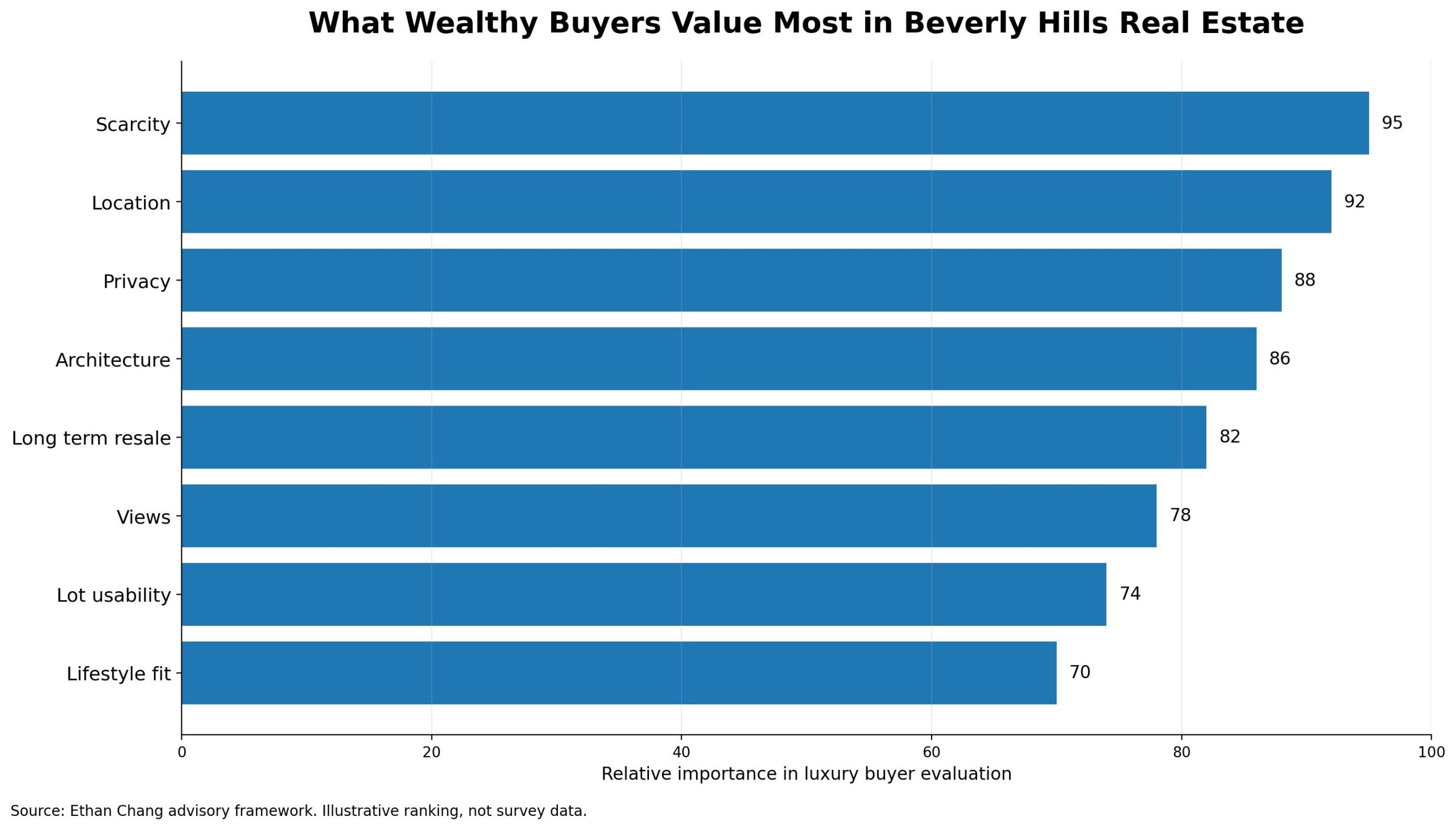
One misconception I frequently encounter is the belief that luxury real estate is primarily about square footage.
In reality, the rarest qualities often create the greatest value.
An unobstructed view.
Complete privacy.
A wide frontage.
A flat usable lot.
Timeless architecture.
Exceptional natural light.
Walkability.
These characteristics cannot be manufactured after closing.
They either exist, or they don’t.
Sophisticated buyers recognize this immediately.
They understand that while kitchens can be remodeled and landscaping redesigned, truly scarce attributes become more valuable over time because there will never be more of them.
In many respects, luxury real estate behaves more like fine art than conventional housing.
Scarcity drives value.
Not abundance.
Beverly Hills Isn’t One Market
People often speak about “the Beverly Hills market” as though every property competes with every other.
Professionally, I almost never think that way.
Beverly Hills is a collection of distinct micro markets.
A traditional estate in The Flats appeals to an entirely different buyer than a contemporary architectural home in Trousdale Estates.
A secluded hillside residence north of Sunset Boulevard attracts different priorities than a walkable property near the Golden Triangle.
Even homes located only a few blocks apart may compete for completely different buyers.
The same principle extends across neighboring luxury communities.
Bel Air emphasizes privacy, estate scale, and larger parcels.
Westwood attracts professionals who value proximity to UCLA, Century City, and Beverly Hills.
Brentwood balances generous homesites with an established residential feel.
Santa Monica combines luxury ownership with an active coastal lifestyle.
Pacific Palisades continues evolving as rebuilding efforts gradually reshape portions of the community.
Malibu remains defined by extraordinary scarcity, ocean frontage, and lifestyle.
West Hollywood appeals to buyers seeking design, culture, dining, and walkability.
Mid Wilshire continues attracting buyers who appreciate historic architecture and central access to Los Angeles.
Understanding these differences often creates more value than memorizing countywide statistics.
What Sophisticated Buyers Evaluate Before They Ever Discuss Price
One of the biggest misconceptions about luxury real estate is that wealthy buyers negotiate differently because they simply have more money.
In reality, they negotiate differently because they evaluate risk differently.
Price is only one variable in a much larger equation.
Before discussing purchase price, experienced buyers are already asking questions that rarely appear in online listings or market reports.
They want to understand how difficult it would be to recreate the property if it disappeared tomorrow.
Would today’s zoning regulations even allow another home like this to be built?
How much would construction cost under today’s labor and material pricing?
Is the architecture timeless, or is it likely to feel dated within a decade?
Does the floor plan support how affluent families actually live today?
These questions often reveal more about long term value than the asking price itself.
Luxury real estate is ultimately about replacement cost and scarcity.
The more difficult a property is to replicate, the more resilient its value tends to become over time.
The Difference Between Expensive and Valuable
Not every expensive home is valuable.
Likewise, some of the most valuable properties initially appear overpriced.
The distinction usually becomes clear only after understanding why the property commands a premium.
A home may justify a higher valuation because of its location on one of Beverly Hills’ most desirable streets.
Another may possess architectural significance that would be nearly impossible to duplicate today.
Some properties enjoy protected views, exceptional privacy, larger usable lots, or a combination of characteristics that rarely come together in a single residence.
Those qualities are difficult to quantify in a spreadsheet.
Yet they frequently become the reasons buyers remain satisfied with their purchase years later.
The opposite is equally true.
A property may appear attractively priced while carrying hidden compromises that become more apparent after closing.
Busy streets.
Limited privacy.
Outdated floor plans.
Deferred maintenance.
Future development nearby.
These issues may not prevent a sale, but they can influence future appreciation and resale potential.
Understanding that distinction is one of the most valuable services an experienced advisor can provide.
Luxury Buyers Think Like Long Term Investors
Many affluent buyers are surprised when I tell them that I spend relatively little time trying to predict where prices will be six months from now.
Markets are influenced by hundreds of variables that no one can forecast with complete certainty.
Interest rates.
Inflation.
Global events.
Financial markets.
Government policy.
Consumer confidence.
All of these factors can change quickly.
What rarely changes, however, is the long term desirability of truly exceptional real estate.
That is why I encourage clients to think beyond the next quarter.
Instead, we discuss questions like:
Will this property still feel special ten years from now?
Will future buyers appreciate its architecture?
Could someone realistically recreate this home today?
If construction costs continue rising, does replacement become even more difficult?
When buyers shift their focus from short term price movements to long term quality, purchasing decisions become much clearer.
Market Conditions Still Matter—But Not for the Reasons Most People Think
This doesn’t mean market data should be ignored.
Far from it.
The June 22 Los Angeles County Housing Report shows that the market is gradually transitioning into its normal summer pattern. Inventory has increased while buyer demand has remained relatively flat, creating a more balanced environment than many buyers experienced during the spring.
Many people immediately interpret that as a signal to negotiate harder.
I interpret it differently.
Balanced markets provide something much more valuable.
Time.
Time to compare homes.
Time to study neighborhoods.
Time to review inspections carefully.
Time to evaluate renovation costs.
Time to understand why one property deserves a premium while another may not.
Luxury buyers rarely regret spending more time on due diligence.
They often regret making decisions too quickly.
Every Neighborhood Solves a Different Lifestyle Question
One mistake buyers sometimes make is searching for the “best” luxury neighborhood.
There isn’t one.
Every community solves a different problem.
Beverly Hills appeals to buyers seeking prestige, timeless architecture, exceptional municipal services, and global recognition.
Bel Air attracts those who prioritize privacy, larger estates, gated properties, and expansive grounds.
Westwood offers convenience, academic prestige, and immediate access to UCLA, Century City, and Beverly Hills.
Brentwood combines generous lot sizes with a neighborhood atmosphere that appeals to families and professionals alike.
Santa Monica attracts buyers who want luxury ownership without sacrificing an active coastal lifestyle.
Pacific Palisades is entering a new chapter as rebuilding efforts gradually reshape portions of the community, creating opportunities for buyers who think beyond today’s headlines.
Malibu remains one of California’s most irreplaceable coastal markets, where limited supply and extraordinary oceanfront settings continue to define value.
West Hollywood offers a completely different luxury experience centered around design, restaurants, nightlife, walkability, and culture.
Mid Wilshire continues attracting buyers who appreciate historic architecture, museums, central location, and a neighborhood undergoing thoughtful reinvestment.
The question is rarely which neighborhood is objectively better.
The better question is which neighborhood best supports the lifestyle you want to create.
That answer is different for every buyer.
Luxury Real Estate Rewards Conviction, Not Perfection
One lesson continues to stand out after years working with luxury clients.
The buyers who consistently make the strongest long term decisions are not the ones waiting for perfect market conditions.
They’re the ones who recognize extraordinary opportunities when they appear.
Perfection rarely exists in real estate.
Every property involves tradeoffs.
Every market contains uncertainty.
The goal is not to eliminate uncertainty.
The goal is to understand it well enough to make confident decisions.
That is often the difference between purchasing a beautiful home…
…and acquiring a truly exceptional asset.
Looking Beyond the Listing
Luxury real estate has always been about more than acquiring a beautiful home.
It is about making a decision that continues to feel right years after the transaction has closed.
That perspective often changes how buyers evaluate opportunities.
Instead of asking whether a kitchen is fashionable today, they consider whether the home’s architecture will remain relevant a decade from now.
Instead of focusing exclusively on square footage, they evaluate how the property lives. Is there a natural flow between indoor and outdoor spaces? Does the floor plan support entertaining as comfortably as everyday living? Are the proportions timeless rather than driven by passing design trends?
Those questions rarely produce dramatic headlines.
Yet they often determine whether a home becomes a lasting source of satisfaction or one that owners quickly outgrow.
One of the most valuable exercises I encourage buyers to do is to imagine owning the property for ten years.
Would they still be excited to come home every evening?
Would the architecture still inspire them?
Would the location continue supporting the lifestyle they value?
If the answer is yes, temporary market fluctuations become far less important.
Why Context Matters More Than Comparables
Comparable sales are an essential part of every purchase, but they should never be viewed in isolation.
Two homes can sell for nearly the same price while representing very different values.
Perhaps one sits on a quieter street with better privacy.
Perhaps another offers a larger, more usable lot or a floor plan that better reflects today’s lifestyle.
One home may have undergone a thoughtful renovation with exceptional craftsmanship, while another simply received cosmetic updates before coming to market.
These differences rarely fit neatly into a spreadsheet.
That is why interpreting comparable sales requires judgment as much as analysis.
The June 22 Los Angeles County Housing Report provides valuable insight into broader market conditions, but every property ultimately competes within its own context. Countywide trends help explain the environment buyers are operating in, yet individual homes continue to succeed or struggle for reasons that often have little to do with the broader market.
Understanding that distinction allows buyers to recognize opportunities that may not be obvious to everyone else.
Patience Should Create Clarity, Not Indecision
Balanced markets naturally give buyers more time.
How that time is used often determines the outcome.
Some buyers spend months waiting for certainty that never arrives.
Others use the additional time to deepen their understanding of neighborhoods, compare architectural styles, review disclosure packages carefully, and refine what truly matters to them.
Those are very different approaches.
Patience is valuable only when it leads to better decisions.
Otherwise, it simply delays them.
The buyers who consistently make the strongest purchases are usually those who become more informed while the market gives them breathing room.
They do not confuse waiting with progress.
They use the extra time to build confidence.
The Last Word
Every market cycle creates a new narrative.
Some years, people are convinced prices can only rise.
Other years, they become convinced the perfect opportunity is just around the corner if they wait a little longer.
Both perspectives can become distractions.
The buyers who achieve the strongest long term outcomes usually focus on something far more enduring.
They look for properties that are difficult to replace.
They understand the character of each neighborhood.
They evaluate quality before price.
And they recognize that exceptional homes rarely become available simply because the calendar says they should.
The June housing report suggests Los Angeles is entering a more balanced phase of the market, giving buyers additional time to evaluate opportunities thoughtfully. For many, that may prove more valuable than any single market statistic.
Real estate will always move through cycles.
Extraordinary properties remain extraordinary regardless of those cycles.
Finding them—and recognizing their value before everyone else does—is where experience makes the greatest difference.
Frequently Asked Questions
Why do luxury buyers evaluate Beverly Hills differently than other markets?
Luxury buyers often focus on long term value rather than short term market fluctuations. They evaluate scarcity, architectural quality, privacy, location, and future desirability alongside financial considerations.
Is Beverly Hills still a good long term investment?
Historically, Beverly Hills has remained one of the world’s most recognized luxury residential markets because of its limited supply, global appeal, and enduring reputation. Individual property selection, however, is just as important as choosing the neighborhood itself.
How is Beverly Hills different from Bel Air?
While both are premier luxury communities, Beverly Hills often emphasizes prestige, walkability, and municipal services. Bel Air generally appeals to buyers seeking larger estates, greater privacy, and more expansive grounds.
Why is local expertise so important in luxury real estate?
Luxury properties compete within highly specific micro markets. Two homes with similar asking prices can offer very different long term value depending on location, architecture, lot characteristics, privacy, and buyer demand.
What should luxury buyers focus on before making an offer?
Beyond pricing, buyers should evaluate architectural significance, construction quality, lot orientation, privacy, future development nearby, replacement cost, neighborhood trends, and long term resale potential.
Thinking About Buying in Beverly Hills or the Westside?
Whether you’re considering a classic estate in Beverly Hills, a private retreat in Bel Air, a family home in Brentwood, a coastal residence in Santa Monica or Malibu, or a contemporary property in West Hollywood, every luxury purchase deserves thoughtful analysis beyond the listing price.
My role is not simply to help clients buy or sell real estate. It is to help them recognize opportunities, understand risk, and make decisions that continue to make sense long after closing.
If you’re exploring luxury real estate in Beverly Hills, Bel Air, Westwood, Brentwood, Santa Monica, Pacific Palisades, Malibu, West Hollywood, or Mid Wilshire, I’d be happy to discuss your goals and help you evaluate which opportunities truly deserve your attention.
