

 Facebook
 X
X
 Pinterest
 Copy Link
Why Some Los Angeles Homes Sell Fast While Others Sit
Why Some Los Angeles Homes Sell Fast While Others Sit
The market for Los Angeles homes has changed significantly over the past year. While many headlines focus on rising inventory and longer market times, they rarely explain why some properties continue attracting strong interest almost immediately while others remain unsold for months.
That difference is rarely caused by luck.
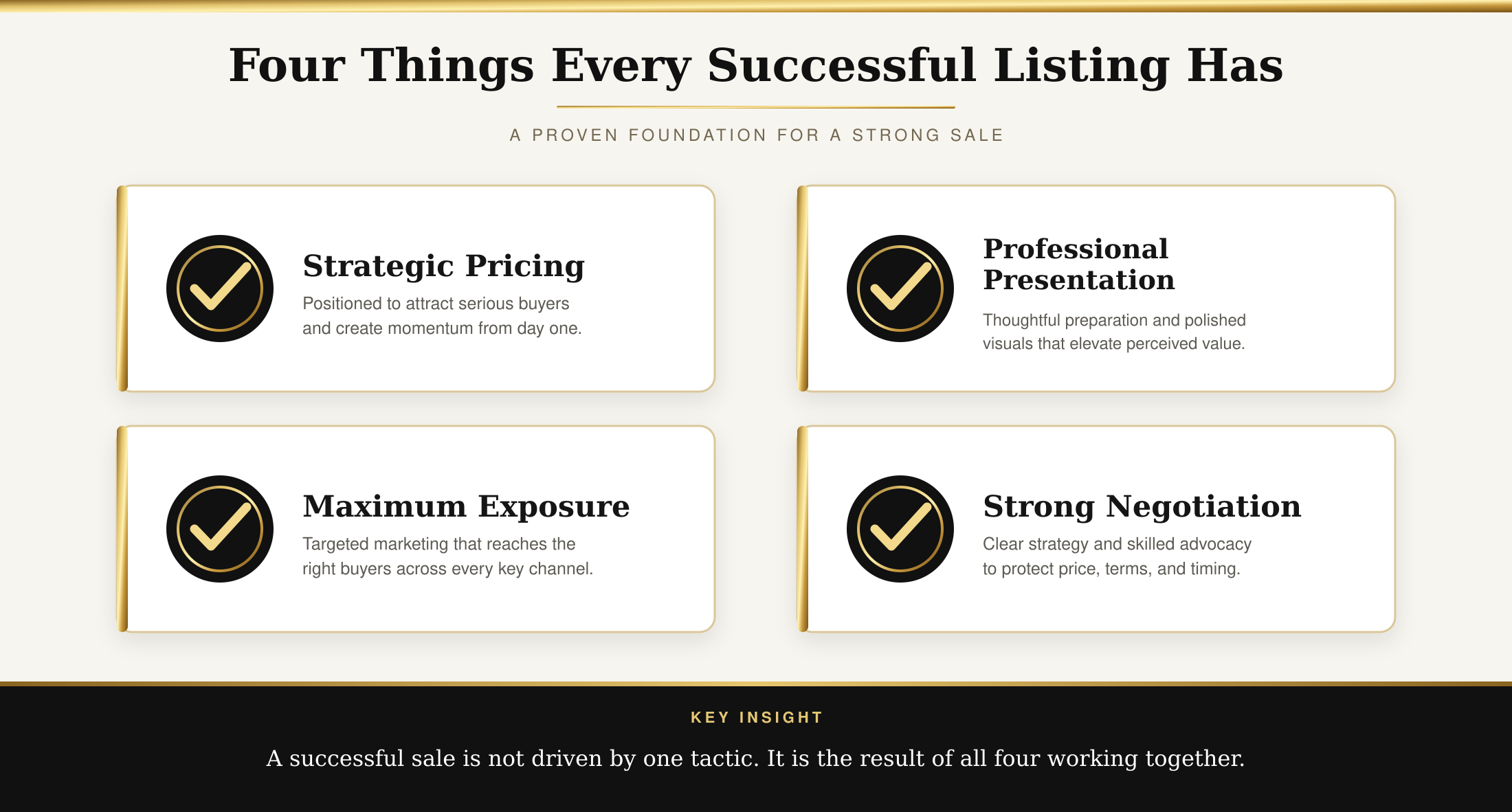
Instead, it usually comes down to preparation, pricing, presentation, and marketing strategy.
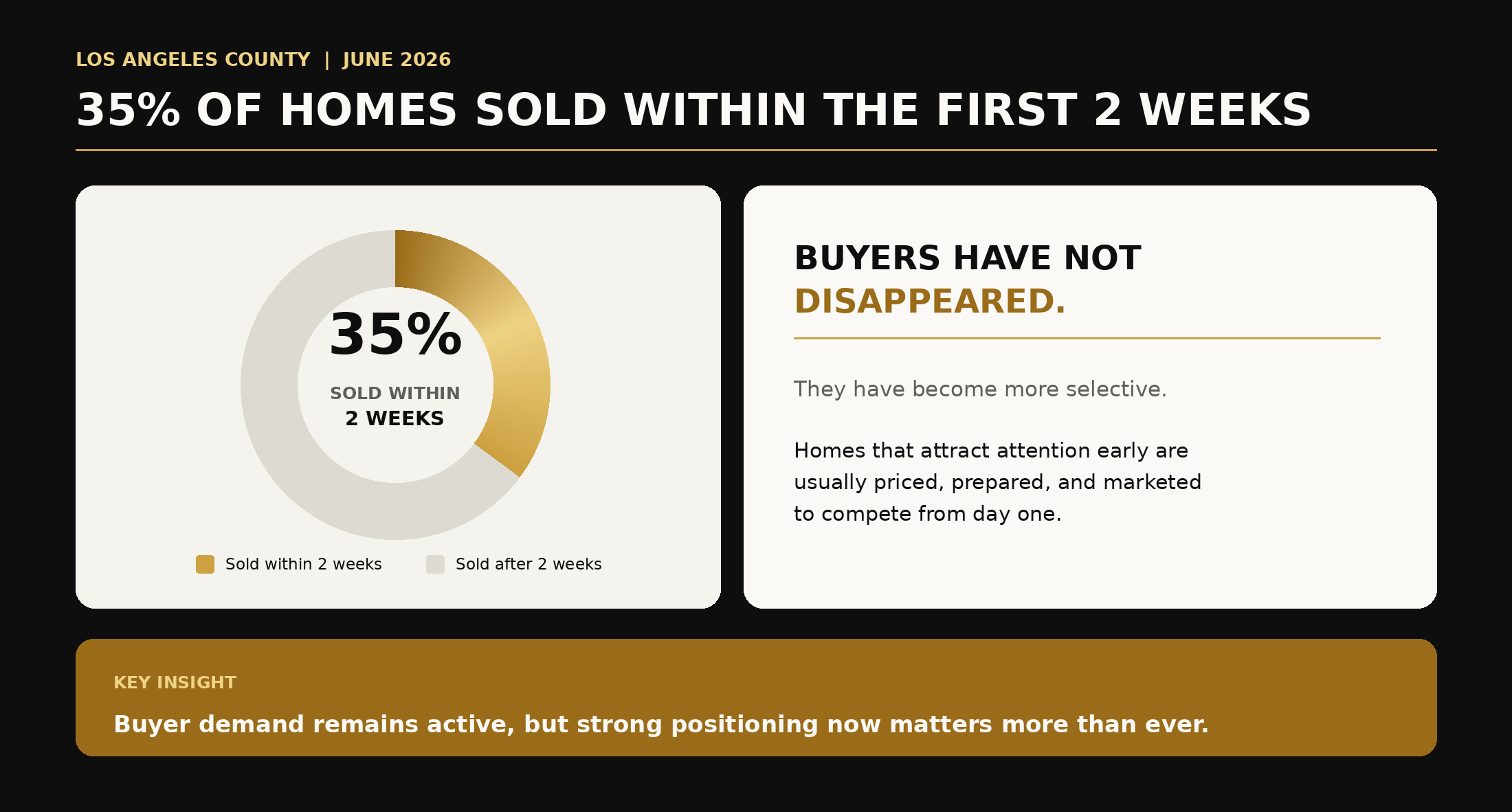
According to the latest Los Angeles County Housing Report, approximately 35% of all homes that closed in June sold within their first two weeks on the market.
That statistic tells us one important thing.
Qualified buyers are still actively purchasing Los Angeles homes.
They have simply become much more selective.
The Market Is More Competitive, Not Broken
Inventory has increased while buyer demand has softened compared with previous years. As a result, buyers have more choices and more negotiating power than they did during the highly competitive market of 2021 and early 2022. Expected market time across Los Angeles County has also increased.
However, averages only tell part of the story.
Exceptional homes continue to attract buyers quickly because they stand apart from competing listings.
Buyers Decide Online Before Scheduling a Showing
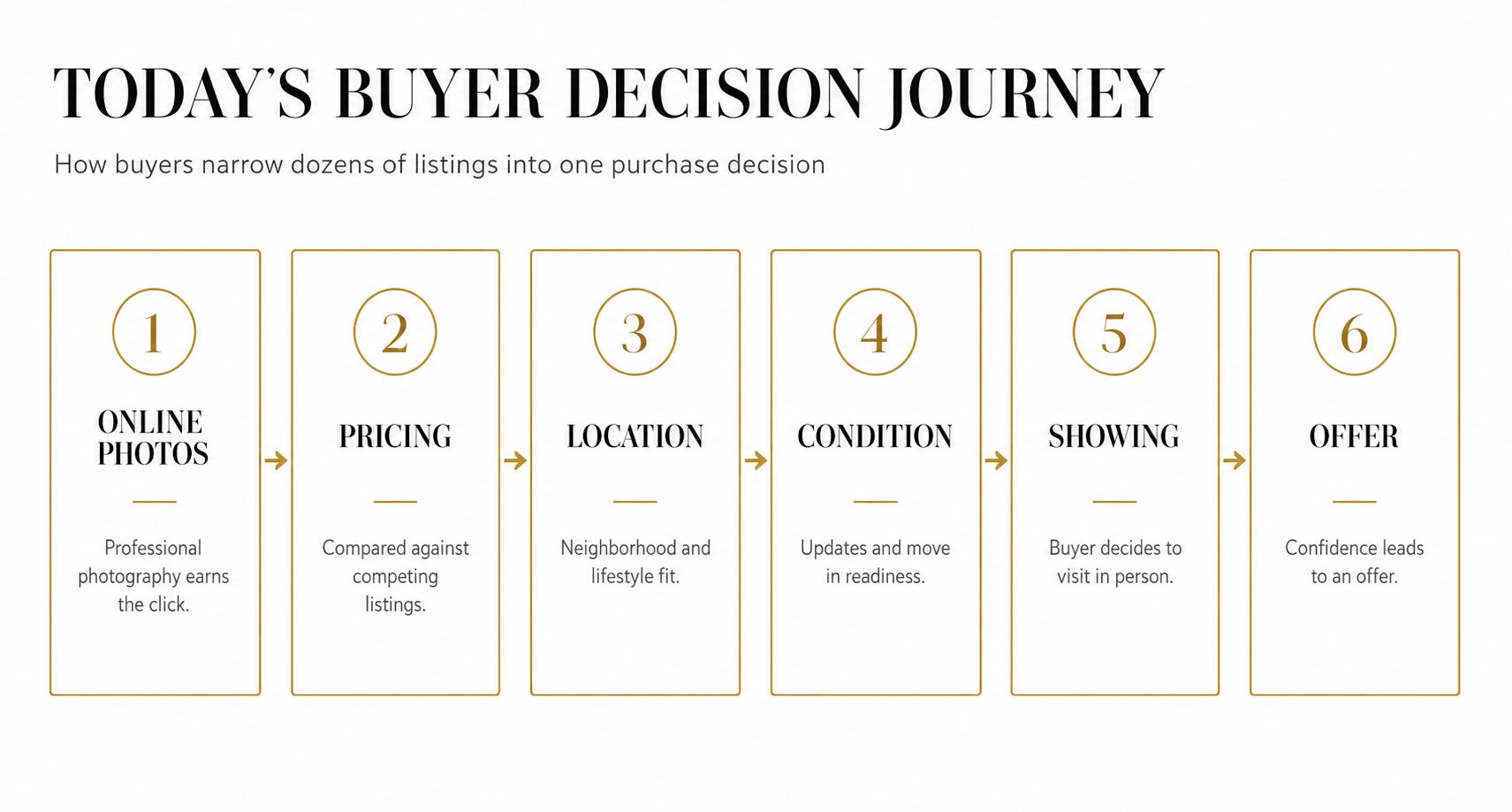
Most buyers form their first impression long before they walk through the front door.
Professional photography, thoughtful staging, accurate pricing, compelling descriptions, and strong visual presentation all influence whether buyers schedule a showing.
Today’s buyers often compare dozens of listings before selecting just a handful to visit.
If a property fails to make an immediate impression online, many buyers simply move on.
Turnkey Homes Continue to Outperform
Many buyers today prefer homes requiring little or no immediate renovation.
Higher borrowing costs and rising construction expenses have increased the value of move-in ready properties.
Updated kitchens.
Modern bathrooms.
Fresh paint.
Quality flooring.
Energy-efficient systems.
These improvements often create stronger buyer confidence and reduce negotiation challenges.
Homes requiring significant repairs can certainly sell, but pricing becomes even more important.
Pricing Creates Opportunity
Price alone rarely determines whether a home sells quickly.
Pricing creates interest.
Presentation creates emotion.
Marketing creates competition.
When those three elements work together, sellers place themselves in the strongest negotiating position.
Conversely, an overpriced listing often loses momentum after its first few weeks on the market.
The First Two Weeks Are Critical
The greatest buyer attention typically occurs immediately after a home is listed.
Serious buyers who have been monitoring the market often schedule showings within days.
That early exposure provides the best opportunity to generate multiple showings and stronger offers.
Once a property remains on the market for several weeks without meaningful activity, buyers often begin wondering whether something is wrong with the home, even when nothing has changed.
Luxury Homes Require Even Greater Precision
Luxury buyers throughout Beverly Hills, Bel Air, Brentwood, Westwood, Santa Monica, Pacific Palisades, and Malibu have become increasingly selective.
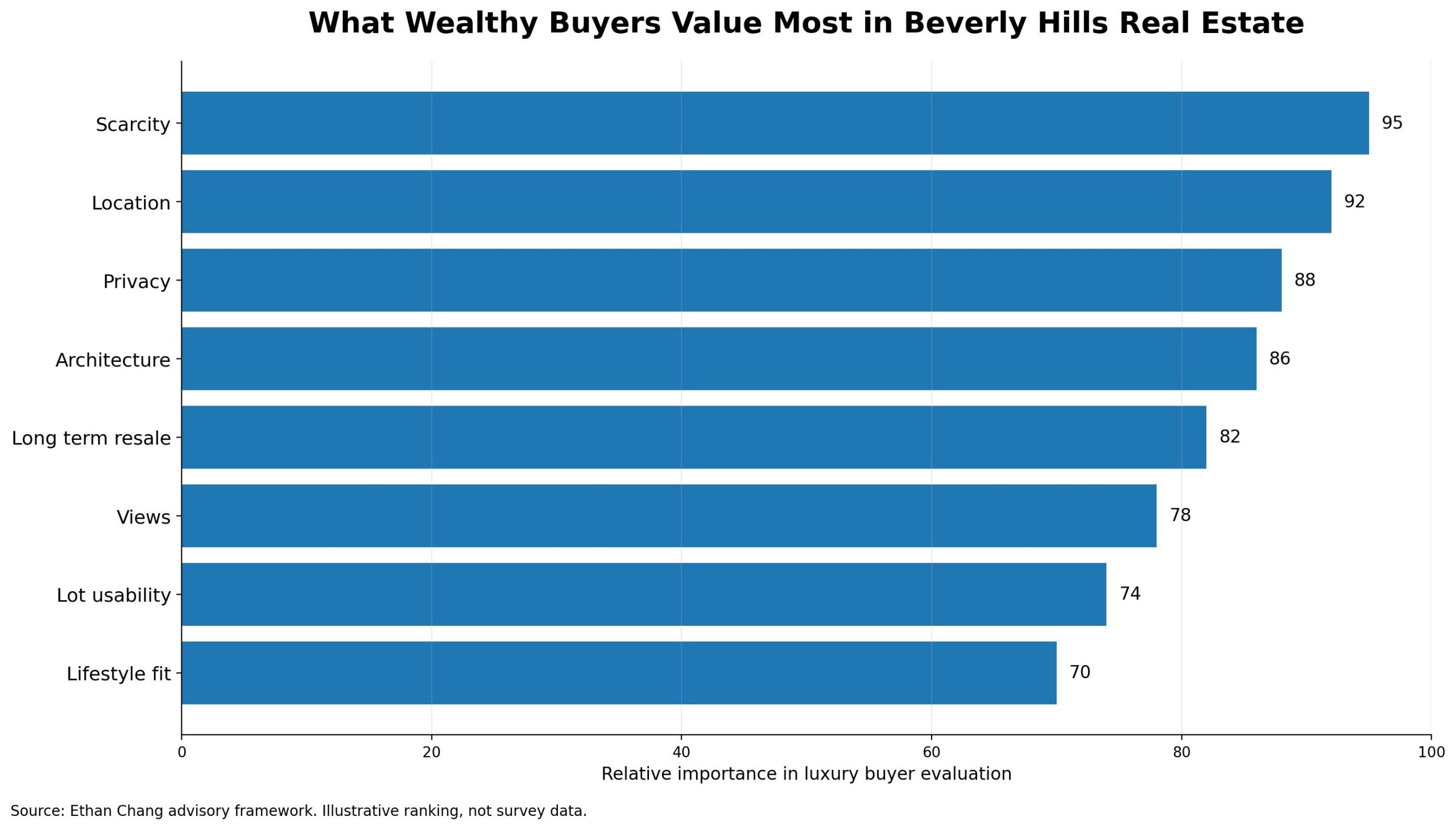
Higher inventory gives affluent buyers more opportunities to compare architecture, design, privacy, views, and overall value.
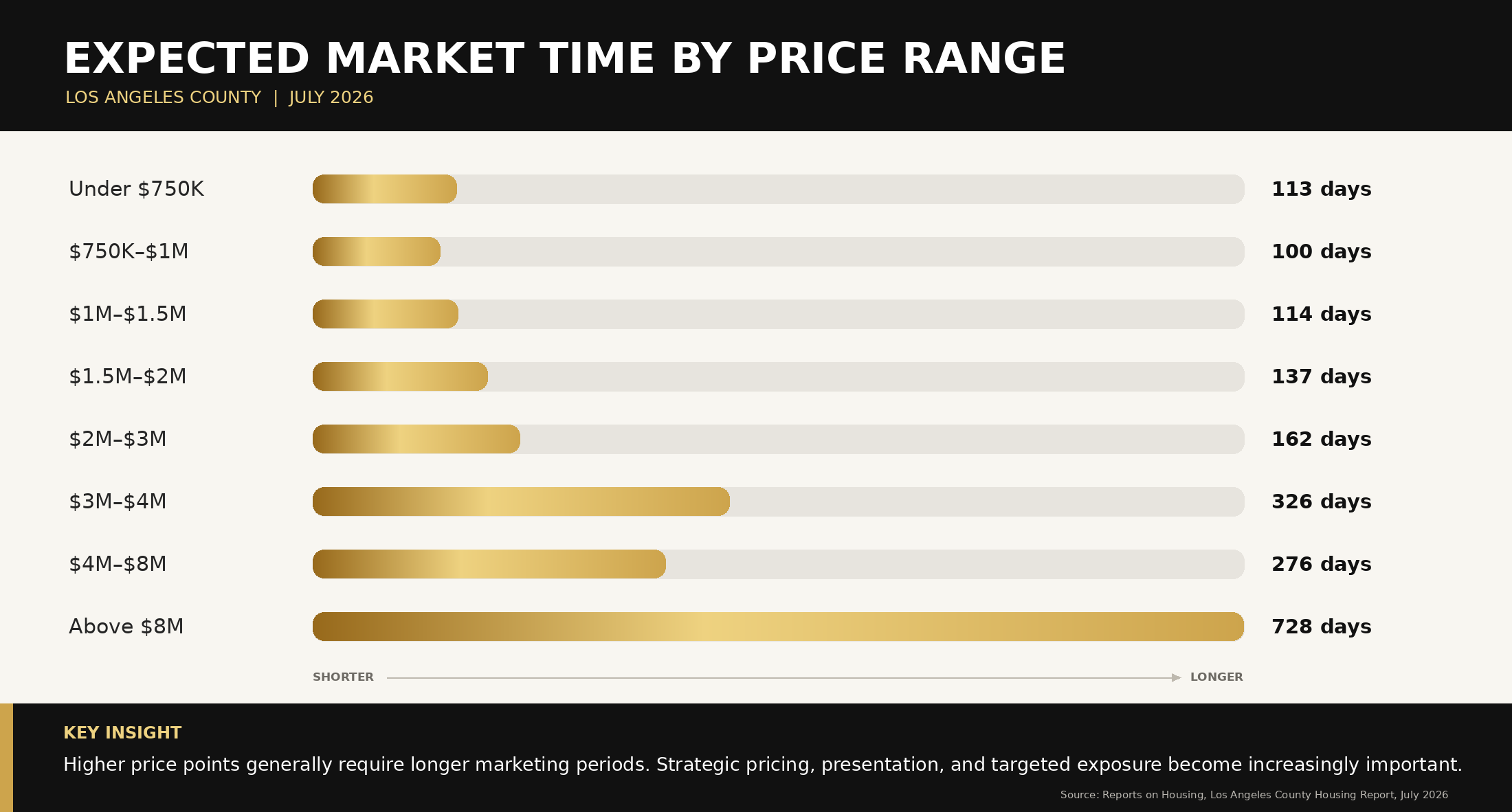
The July Housing Report shows considerably longer expected market times for higher price ranges, reinforcing the importance of strategic pricing and professional marketing for luxury properties.
Exceptional homes continue attracting buyers.
Average listings face much greater competition.
Marketing Has Become a Competitive Advantage
Today’s marketing extends far beyond the MLS.
Successful listings often include:
- Professional photography
- Cinematic video
- Drone imagery
- Social media campaigns
- Broker networking
- Targeted digital advertising
- International exposure
- Strategic open houses
Marketing should generate demand, not simply announce availability.
Final Thoughts
Today’s market rewards preparation.
The Los Angeles homes that continue selling quickly are rarely accidental successes. They are usually the result of thoughtful pricing, exceptional presentation, and strategic marketing from the very beginning.
Whether you’re preparing to sell a condominium in Westwood, a family home in Brentwood, or a luxury estate in Beverly Hills or Bel Air, careful planning can make a meaningful difference in both timing and outcome.
Luxury Home Buyers in Beverly Hills: The Hidden Cost of Waiting to Buy
The Hidden Cost of Waiting to Buy a Luxury Home in Beverly Hills
Every Real Estate Decision Has a Cost—Including Waiting
One of the biggest misconceptions in luxury real estate is that delaying a purchase is the safest financial decision.
On the surface, it seems logical.
If there’s uncertainty about the economy, interest rates, or housing prices, waiting can feel like the prudent choice. Many buyers assume that postponing a purchase allows them to gather more information, avoid risk, and potentially secure a better deal in the future.
Sometimes that’s true.
But there’s another side to the equation that receives far less attention.
Waiting has a cost.
Not just financially, but strategically and personally.
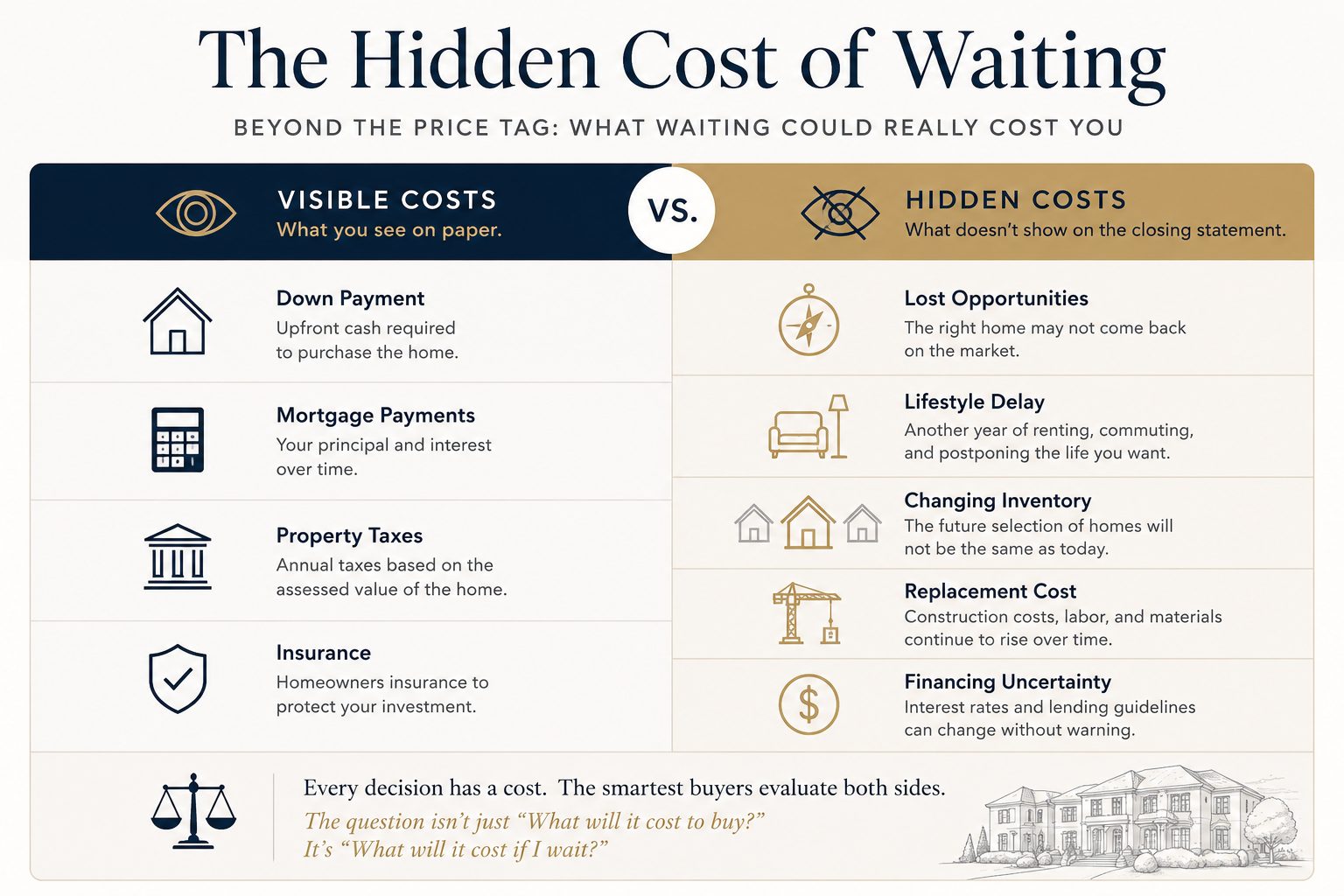
The challenge is that these costs rarely appear on a closing statement or monthly mortgage payment. They’re often invisible until years later, when buyers realize the opportunity they passed on cannot easily be recreated.
As someone with a background in accounting before entering luxury real estate, I’ve learned that the best decisions are rarely made by evaluating only one side of the ledger.
Every investment carries a cost.
So does every delay.
The question isn’t simply whether you should buy today.
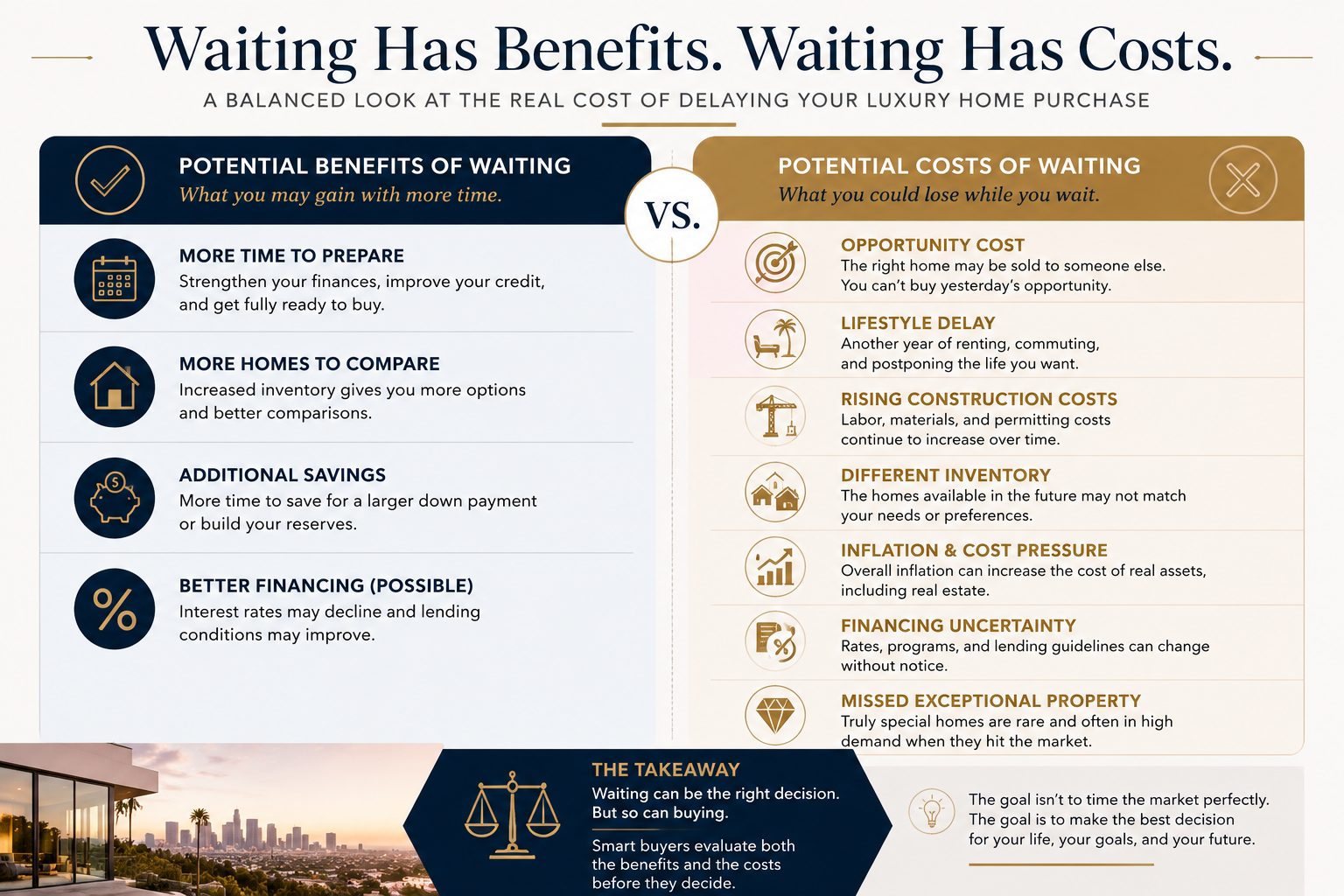
The better question is whether the benefits of waiting outweigh the opportunities you may be giving up.
That answer is different for every buyer.
Opportunity Cost Isn’t Just an Investment Term
Economists use the phrase opportunity cost to describe the value of the alternative that wasn’t chosen.
Most people understand the concept when discussing stocks, businesses, or financial investments.
Real estate is no different.
Imagine identifying a home that checks nearly every box.
The location feels right.
The floor plan works.
The neighborhood fits your lifestyle.
You decide to wait six months because you’re hoping prices soften.
Six months later, that particular home has sold.
Perhaps another property becomes available.
Perhaps it doesn’t.
Maybe the replacement lacks the same privacy, views, lot size, natural light, or architectural character.
The comparison is no longer between buying today or buying later.
It’s between owning that property or settling for a different one.
Opportunity cost isn’t measured by the home’s asking price.
It’s measured by what can no longer be purchased.
That distinction becomes increasingly important in Beverly Hills, Bel Air, Brentwood, Santa Monica, Pacific Palisades, Malibu, West Hollywood, Westwood, and Mid Wilshire, where truly exceptional properties represent a relatively small percentage of the overall housing inventory.
The June Housing Report Reveals Something Many Buyers Overlook
One statistic from the June 22 Los Angeles County Housing Report stood out to me—not because it was dramatic, but because of what it suggests about today’s market.
Despite higher borrowing costs and a slower pace of sales, distressed inventory remains exceptionally low. Nearly every homeowner still has equity, giving most sellers the flexibility to hold rather than sell under pressure.
That changes the dynamics of waiting.
Many buyers continue hoping that a wave of distressed sales or significant price reductions will eventually arrive.
The current data doesn’t support that expectation.
Instead, today’s market appears to be characterized by patient buyers meeting patient sellers.
Neither side is being forced into rapid decisions.
That’s an important distinction because it means buyers waiting solely for widespread distress may be waiting for conditions that never develop.
Markets certainly evolve.
Prices can rise or fall.
Individual sellers may become more motivated.
But those situations tend to occur property by property rather than across the entire luxury market.
The Cost That Doesn’t Appear on Paper
When people think about the cost of buying a home, they usually calculate the down payment, financing, insurance, taxes, and maintenance.
Those are all real expenses.
Far fewer people calculate the cost of continuing to wait.
Waiting may mean another year of renting.
Another year of commuting farther than you’d like.
Another year without the outdoor space you’ve been envisioning.
Another year postponing a lifestyle you’ve already decided you want.
These aren’t merely emotional considerations.
They’re part of the total return on a real estate decision.
A luxury home is more than a financial asset.
For many buyers, it’s where families gather, careers evolve, memories are created, and daily routines become more enjoyable.
The value of those experiences can’t always be captured in a spreadsheet, but that doesn’t make them any less real.
Sophisticated buyers recognize that financial returns and quality of life often complement each other rather than compete.
A Balanced Perspective
None of this suggests that every buyer should purchase immediately.
In fact, there are circumstances where waiting is absolutely the right decision.
If your finances aren’t ready…
If you’re uncertain about where you want to live…
If your career or family situation may change significantly over the next year…
Waiting may be the smartest move you can make.
Good decisions begin with clarity, not urgency.
The objective isn’t to convince yourself to buy sooner.
It’s to evaluate the full cost of every available option—including the cost of doing nothing.
That perspective often leads to more thoughtful decisions than focusing exclusively on whether prices might move up or down over the next few months.
The Market Doesn’t Have to Rise for Waiting to Become Expensive
One of the biggest assumptions buyers make is that the cost of waiting depends entirely on whether home prices increase.
In reality, that is only one variable.
Even in a relatively stable market, waiting can become more expensive because other factors continue changing in the background.
Construction costs rarely remain static.
Insurance premiums evolve.
Property taxes adjust over time.
Financing conditions shift.
Lifestyle priorities change.
Meanwhile, the inventory available today is almost never identical to the inventory available six months from now.
The decision isn’t simply whether prices will move.
It’s whether tomorrow’s opportunities will resemble today’s.
That distinction often matters far more than a modest change in market value.
The Opportunity You Remember Isn’t Always the One You Bought
Ask homeowners about the property they purchased, and many will tell you they love their home.
Ask them about the property they almost bought, and the stories become surprisingly vivid.
“The one with the incredible backyard.”
“The one overlooking the canyon.”
“The one we hesitated on.”
Years later, buyers often remember the opportunities they let slip away more clearly than the negotiations themselves.
That observation isn’t emotional.
It’s practical.
Luxury real estate is highly individualized.
No two properties are exactly alike.
Once a home is sold, buyers aren’t comparing today’s market with yesterday’s market.
They’re comparing today’s available inventory with a specific opportunity that no longer exists.
That’s an important difference.
Time Changes Buyers as Much as Markets
One lesson I’ve learned is that buyers evolve just as quickly as markets do.
A couple purchasing their first luxury home today may have very different priorities five years from now.
Children arrive.
Parents move closer.
Businesses expand.
Retirement plans change.
Working from home becomes permanent.
The ideal property evolves with life itself.
Waiting sometimes provides greater clarity.
Other times, it simply delays the lifestyle buyers already know they want.
That is why I encourage clients to evaluate both the financial and personal dimensions of timing.
The goal isn’t simply to purchase at the lowest possible price.
It’s to purchase at the point where the property meaningfully improves your life.
Today’s Market Rewards Preparation More Than Prediction
Much of the public conversation surrounding real estate revolves around predictions.
Where are interest rates going?
Will prices rise?
Will inventory increase?
Will the economy slow?
Those questions are interesting.
They’re also impossible to answer with certainty.
Preparation, however, is entirely within a buyer’s control.
Understanding financing.
Knowing your preferred neighborhoods.
Studying architectural styles.
Reviewing comparable sales.
Clarifying your priorities before the right property appears.
Prepared buyers tend to make better decisions because they’re responding to opportunity instead of reacting to uncertainty.
One insight from the June 22 Los Angeles County Housing Report supports this idea.
As inventory has increased, buyers have gained additional time to evaluate homes rather than competing under the intense pressure that characterized previous years. That additional time can become a significant advantage—but only if it’s used thoughtfully.
More time should improve decision quality.
Not prolong indecision.
Why Some Buyers Wait for the Perfect Market
Psychologists have long observed that people naturally prefer avoiding mistakes over capturing opportunities.
In investing, this often means holding cash while waiting for the “perfect” entry point.
Real estate is no different.
Many buyers postpone decisions because they fear purchasing immediately before prices soften.
It’s an understandable concern.
Yet the opposite outcome receives far less attention.
Waiting while desirable properties disappear.
Waiting while financing changes unexpectedly.
Waiting until personal priorities evolve.
Waiting until the home that fit perfectly is no longer available.
No decision is entirely free of risk.
Buying carries uncertainty.
Waiting carries uncertainty as well.
The objective isn’t eliminating risk.
It’s understanding which risks are worth accepting.
A Question Worth Asking Before You Wait
Whenever clients tell me they’re considering waiting, I don’t immediately encourage or discourage the decision.
Instead, I ask a different question.
“What specifically are you waiting for?”
Sometimes the answer is perfectly reasonable.
A business transition.
A growing investment portfolio.
A planned move.
Greater financial certainty.
Those are thoughtful reasons to delay.
Other times, buyers are waiting for a general feeling that the market will somehow become easier.
That moment may never arrive.
Real estate rarely offers perfect certainty.
What it does offer is the opportunity to make informed decisions based on today’s facts rather than tomorrow’s assumptions.
That distinction has guided many of the strongest decisions I’ve seen clients make.
When Waiting Is Actually the Right Decision
One concern I have whenever real estate professionals discuss timing is that the conversation often becomes overly simplistic.
You’ll hear statements like:
“Now is always the best time to buy.”
I don’t believe that’s true.
Sometimes waiting is absolutely the right decision.
If you’re uncertain about your career.
If your family may relocate.
If you’re planning a major business transition.
If purchasing today would place unnecessary financial strain on your lifestyle.
Waiting can be the smartest investment you make.
Buying a luxury home should increase your quality of life, not become a source of stress.
The key is ensuring that waiting is an intentional strategy rather than an emotional reaction to uncertainty.
Those are two very different decisions.
What Today’s Market Really Suggests
Housing reports often generate headlines because people naturally want simple conclusions.
Is it a buyer’s market?
Is it a seller’s market?
Should prices rise or fall?
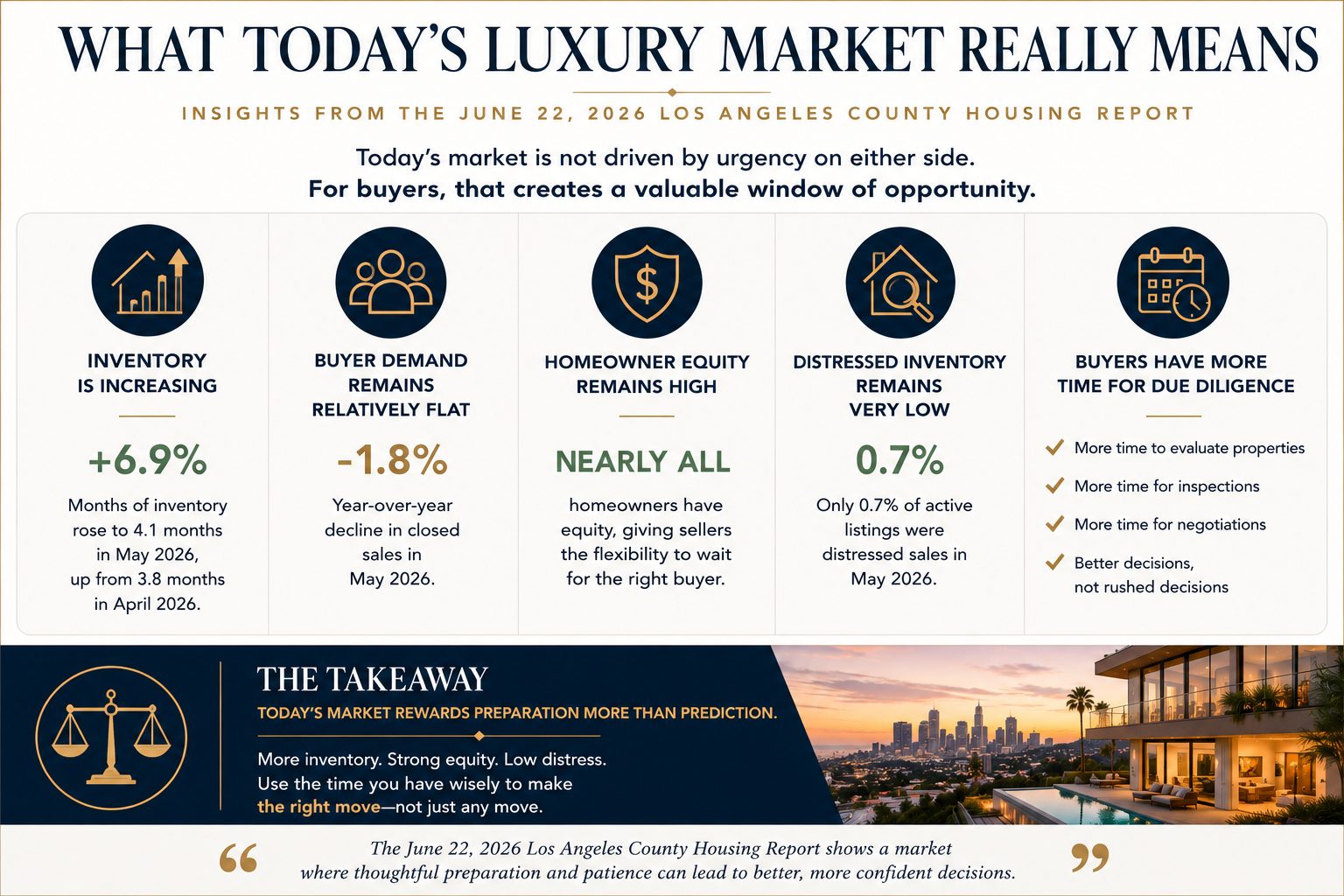
The June 22 Los Angeles County Housing Report tells a more nuanced story.
Inventory has expanded compared with earlier in the year, giving buyers more options to evaluate. At the same time, homeowner equity remains exceptionally strong, meaning relatively few sellers are under pressure to accept significant discounts. The result is a market where thoughtful preparation often matters more than trying to predict the next headline.
That balance is important.
More inventory creates more opportunities to compare properties.
Strong homeowner equity reduces the likelihood of widespread distressed sales.
Neither buyers nor sellers are operating from the same level of urgency seen during previous market cycles.
For buyers, that creates something valuable:
The opportunity to make decisions deliberately.
A Decision Framework I Share With Clients
Rather than asking whether now is the right time to buy, I encourage clients to ask themselves five questions.
1. Have I clearly defined what I’m looking for?
Many buyers begin touring homes before they’ve established their priorities. The clearer your objectives, the easier it becomes to recognize the right opportunity when it appears.
2. Am I financially prepared?
Confidence begins with preparation. Understanding your budget, financing options, and long term objectives allows you to evaluate homes without unnecessary pressure.
3. What am I expecting to change if I wait?
Be specific.
Are you expecting interest rates to decline?
More inventory?
A career change?
Additional savings?
Or are you simply hoping the market becomes easier?
Understanding your reason for waiting often clarifies whether waiting is truly beneficial.
4. What could I lose by postponing the decision?
This question is just as important as asking what you might gain.
Every opportunity has a cost.
So does every delay.
Considering both sides leads to better decisions.
5. If this property were still available one year from now, would I still want it?
Great homes have a way of remaining desirable regardless of market conditions.
If your enthusiasm disappears simply because of changing headlines, the property may never have been the right fit to begin with.
Advisor’s Perspective
One of the greatest privileges of working in luxury real estate is seeing how differently successful people approach important decisions.
The strongest buyers I’ve met are rarely the ones trying to perfectly predict the market.
They’re the ones who gather information, understand the risks, define their priorities, and act confidently when the right opportunity aligns with their goals.
That’s true whether they’re purchasing a primary residence in Beverly Hills, a private estate in Bel Air, a family home in Brentwood, a coastal retreat in Santa Monica or Malibu, or a contemporary residence in West Hollywood.
Markets will always evolve.
Headlines will always change.
The ability to make thoughtful decisions endures.
Frequently Asked Questions
Should I wait for luxury home prices to decline before buying in Beverly Hills?
Every buyer’s situation is different. While prices can fluctuate, today’s market also offers advantages such as increased inventory and additional time for due diligence. The decision should be based on your financial readiness, long term goals, and the quality of the property—not on price expectations alone.
Is waiting always the safest financial decision?
Not necessarily. Waiting can provide more time to prepare, but it may also involve opportunity costs, changing financing conditions, or the loss of a property that closely matches your objectives. Evaluating both the benefits and costs of waiting leads to more balanced decisions.
Are luxury sellers becoming more motivated?
Some individual sellers may adjust their expectations, but the June 22 housing report indicates that most homeowners continue to have substantial equity. That financial strength means many sellers can afford to wait for the right buyer rather than accept significant discounts.
What matters most when evaluating a luxury property?
Every purchase is unique, but buyers should consider factors such as location, architectural quality, privacy, floor plan, future resale potential, neighborhood dynamics, and how well the property aligns with their long term lifestyle and financial goals.
How do I know whether I’m ready to buy?
The right time to buy is rarely determined by headlines alone. It is the point where your financial position, personal objectives, and the right property come together in a way that supports your long term plans.
The Last Word
Buying a luxury home is one of the most significant financial and personal decisions many people will ever make.
It’s natural to focus on purchase price.
It’s equally important to understand the cost of waiting.
Neither decision is inherently right or wrong.
The objective is to make the choice that best aligns with your goals, your financial position, and the life you want to create over the years ahead.
Real estate has never been about finding certainty.
It’s about making informed decisions when certainty doesn’t exist.
When buyers approach the market with preparation, clarity, and realistic expectations, they place themselves in a position to recognize opportunities that others may overlook.
In my experience, those are often the decisions people look back on with the greatest satisfaction.
Luxury Home Buyers in Beverly Hills: Why Wealthy Buyers Think Differently

Why Summer May Not Be the Best Time to Sell Your Los Angeles Home in 2026

North Beverly Park Estate with Panoramic City and Ocean Views
Why Summer May Not Be the Best Time to Sell Your Los Angeles Home in 2026
When homeowners think about the Summer Los Angeles real estate market, many assume it is the ideal time to sell. The weather is beautiful, school is out, families are moving, and neighborhoods are full of activity. On the surface, summer feels like the busiest season for real estate.
The data tells a different story.
While more homes come on the market during the summer months, buyer demand has already peaked in the spring. As inventory continues to grow through July and August, sellers face increasing competition for the same pool of buyers. That shift doesn’t mean homes stop selling. It simply means strategy becomes more important than timing.
For homeowners in Beverly Hills, Bel Air, Westwood, Brentwood, Santa Monica, Pacific Palisades, Malibu, West Hollywood, and Mid Wilshire, understanding this seasonal transition can make the difference between a successful sale and months of unnecessary market time.
Why the Summer Los Angeles Real Estate Market Slows
One of the biggest misconceptions I hear is that summer is the strongest selling season because families prefer to move before school begins.
There is some truth to that.
Many families still want to relocate during the summer. The difference is that most of those buyers began searching months earlier. By late May, buyer demand has typically reached its highest point of the year. As summer begins, vacations, travel, children’s activities, and other commitments gradually pull buyers away from the housing market.
At the same time, many homeowners decide to list, believing they can still capture the momentum of the spring market.
The result is simple:
More homes.
Slightly fewer active buyers.
More competition.
That combination naturally slows the pace of the market.
More Listings Do Not Always Mean More Buyers
The June housing report shows that active inventory continued to increase while buyer demand remained essentially unchanged. As more listings entered the market, the expected market time increased to 114 days, the highest level since the end of January.
This is an important distinction.
Many homeowners look around and notice more “For Sale” signs. They assume that must mean buyers are also becoming more active.
In reality, additional inventory often creates the opposite effect.
Buyers suddenly have more choices.
They compare homes more carefully.
They negotiate more confidently.
They become less willing to compromise.
For sellers, that means earning a buyer’s attention becomes more difficult than it was just a few months earlier.
Why Turnkey Homes Continue to Stand Out
Although the overall market slows during the summer, not every property performs the same way.
One trend has remained remarkably consistent across Beverly Hills, Brentwood, Santa Monica, West Hollywood, and Pacific Palisades.
Homes that are move in ready continue attracting the strongest interest.
Today’s buyers value certainty.
Many prefer avoiding major renovations, permit delays, contractor scheduling challenges, and rising construction costs. A well prepared home allows buyers to move forward with confidence.
Before listing, sellers should carefully evaluate:
- Overall condition
- Deferred maintenance
- Paint and flooring
- Landscaping and curb appeal
- Professional staging
- Photography and video
- Pricing strategy
These improvements may seem straightforward, but together they shape a buyer’s first impression and often determine whether a property becomes a “must see” or simply another listing online.
Pricing Matters Even More During the Summer
As inventory grows, pricing becomes increasingly important.
Some homeowners believe they can list high and negotiate later.
Unfortunately, today’s buyers are more informed than ever.
Before scheduling a showing, many buyers have already reviewed comparable sales, studied neighborhood trends, analyzed days on market, and compared dozens of competing listings.
When a property appears overpriced, buyers often wait.
Instead of creating urgency, an inflated asking price can encourage hesitation.
Ironically, homes that are priced correctly from the beginning frequently receive stronger interest and, in some cases, multiple offers.
Pricing is not simply about maximizing value.
It is about positioning the home to attract the right buyers before competing listings capture their attention.
Every Westside Neighborhood Has Its Own Story
Countywide housing reports provide valuable perspective, but every neighborhood behaves differently.
West Hollywood buyers often prioritize walkability, lifestyle, and updated interiors.
Santa Monica buyers frequently focus on proximity to the beach, schools, and neighborhood character.
Brentwood buyers continue placing a premium on move in ready homes and functional floor plans.
In Beverly Hills and Bel Air, pricing strategy becomes increasingly important because the luxury buyer pool is naturally smaller and purchasing decisions tend to be more deliberate.
Pacific Palisades continues evolving as rebuilding efforts reshape portions of the community, while Malibu remains defined by limited inventory and its unique coastal lifestyle.
Understanding those neighborhood differences is often far more valuable than relying on countywide averages alone.
Advisor’s Perspective
One of the biggest mistakes homeowners make is assuming the calendar determines success.
In my experience, the calendar matters far less than preparation.
I’ve seen well presented homes sell quickly in slower markets, and I’ve watched poorly positioned properties struggle during the busiest months of the year.
The homeowners who achieve the strongest results are usually the ones who begin preparing long before their home reaches the market. They understand local buyer expectations, invest in presentation, and price strategically from day one.
The market may influence your opportunities.
Your strategy often determines your outcome.
Key Takeaways
- The Summer Los Angeles real estate market typically slows as inventory increases and buyer activity eases.
- More listings create greater competition among sellers.
- Turnkey homes continue outperforming properties requiring significant updates.
- Strategic pricing becomes increasingly important during the summer months.
- Every neighborhood behaves differently. Local expertise matters more than countywide averages.
Frequently Asked Questions
Is summer a good time to sell a home in Los Angeles?
Yes, but sellers should understand that competition typically increases during the summer as more homes enter the market while buyer demand gradually slows. Proper pricing and presentation become even more important.
Why does the Summer Los Angeles real estate market slow?
Spring is usually when buyer demand reaches its peak. During the summer, vacations, family activities, and additional inventory create a more balanced market with longer selling times.
Do turnkey homes still sell quickly?
Often, yes. Buyers continue paying premiums for homes that are well maintained, updated, and move in ready because they reduce uncertainty and renovation costs.
Should I wait until fall to list my home?
Not necessarily. Every property and neighborhood is different. The decision should be based on your goals, local market conditions, and how well your home can be positioned against competing listings.
Thinking About Selling Your Home?
Selling successfully isn’t simply about choosing the right month. It’s about understanding your neighborhood, preparing your home thoughtfully, and developing a pricing strategy that reflects today’s market.
If you’re considering selling in Beverly Hills, Bel Air, Westwood, Brentwood, Santa Monica, Pacific Palisades, Malibu, West Hollywood, or Mid Wilshire, I’d be happy to provide a personalized assessment of your home’s position in today’s market and discuss strategies that can help you maximize its value.
