

 Facebook
 X
X
 Pinterest
 Copy Link
The 4 Layers of Property Value: Why Some Los Angeles Homes Continue to Outperform Over Time
When people evaluate a luxury home, they often begin with what they can immediately see.
The architecture.
The kitchen.
The finishes.
The view.
Those features certainly influence a property’s appeal, but after working with buyers and sellers throughout Los Angeles, I’ve found that they explain only part of the story.
Some homes appreciate more consistently than others, even when they were built around the same time or renovated to similar standards. Likewise, two homes with comparable square footage and amenities can experience very different long-term performance simply because they occupy different locations.
That raises an important question.
What actually creates lasting real estate value?
Many people assume the answer is the house itself.
In reality, a property’s long-term performance is shaped by several independent factors, some of which owners can influence and others they cannot.
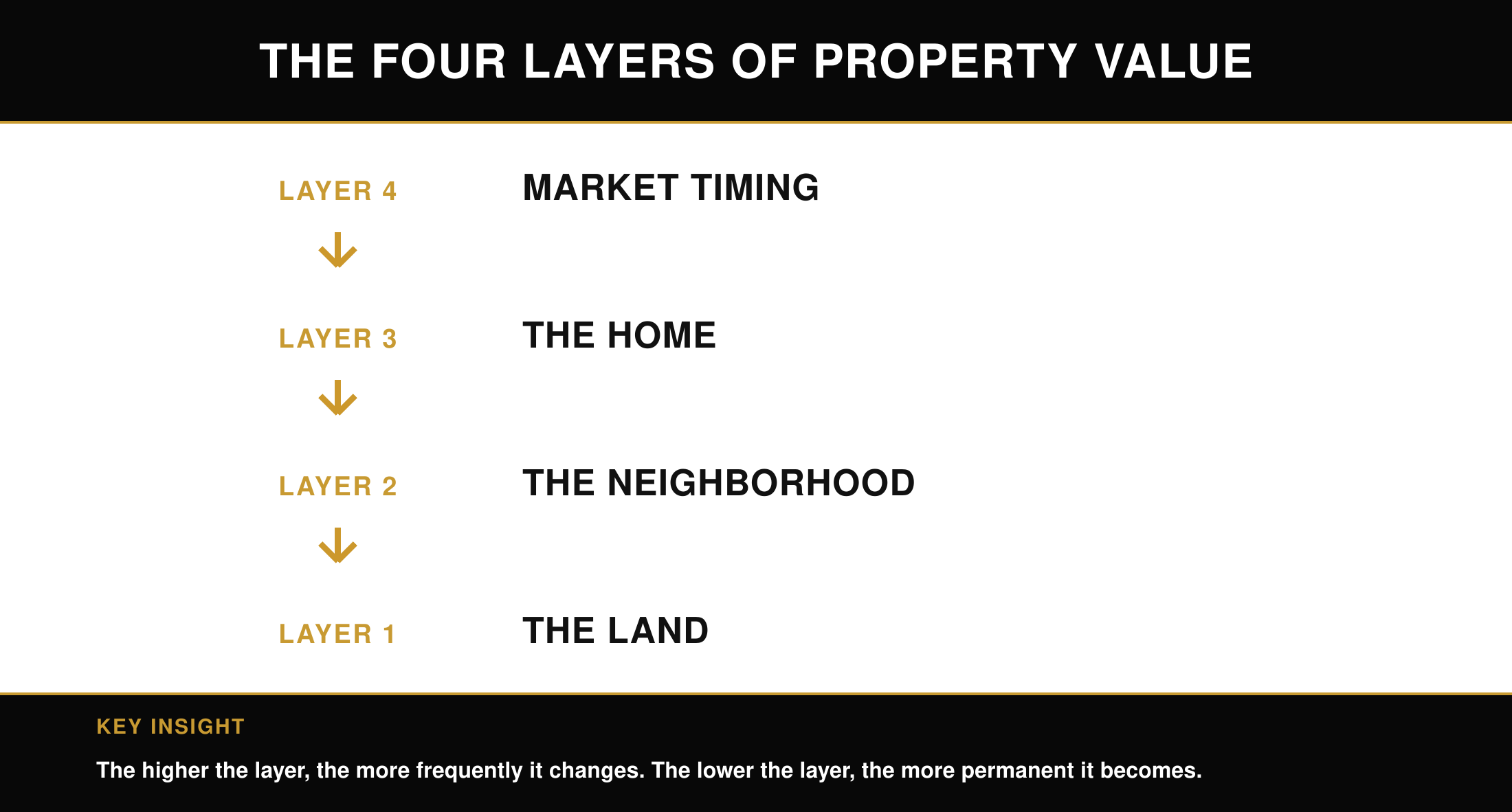
Over the years, I’ve come to think about residential real estate through four distinct layers of value.
Understanding these layers helps explain why certain neighborhoods continue attracting buyers through different market cycles, why some renovations generate exceptional returns while others do not, and why experienced buyers often evaluate much more than the home itself before making an investment.
Layer 1: The Land Is the One Asset That Cannot Be Recreated
Every luxury home begins with something remarkably simple.
A piece of land.
Unlike the home built upon it, land cannot be manufactured, expanded, or relocated. Once a neighborhood is fully developed, its most desirable parcels become increasingly difficult to replace.
This is one reason exceptional locations continue to command premium values over long periods of time.
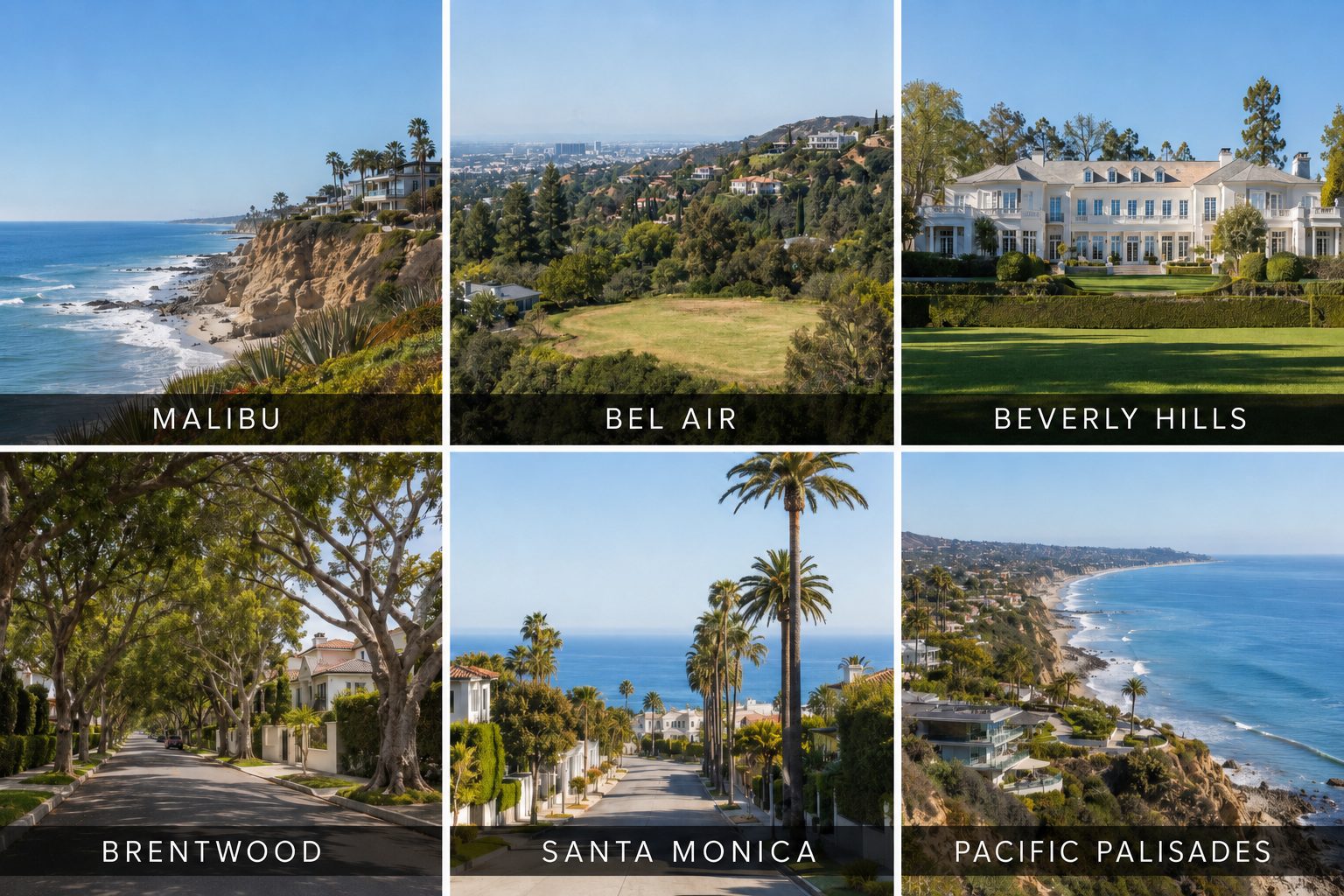
An oceanfront parcel in Malibu cannot be replicated elsewhere.
A south-facing lot with panoramic city views in Bel Air cannot simply be recreated across the street.
Large estate lots in Beverly Hills become more valuable not because someone builds another one, but because opportunities to acquire them become increasingly limited.
Scarcity is one of the most powerful economic forces in real estate.
While homes can be remodeled, expanded, or even rebuilt, truly exceptional land remains finite.
For long-term investors, understanding the quality of the underlying site is often more important than evaluating the finishes currently sitting on top of it.
That’s why experienced buyers often ask questions such as:
- How difficult would it be to find another lot like this?
- Could zoning rules allow similar development nearby?
- Are the views protected?
- Is the surrounding neighborhood already mature?
These questions focus less on today’s appearance and more on tomorrow’s rarity.
Layer 2: Neighborhood Value Compounds Over Decades
If land forms the foundation of value, the neighborhood determines how that value evolves.
Unlike a renovation that can be completed within a year, neighborhoods develop over generations.
Tree-lined streets mature.
Independent restaurants establish loyal followings.
Parks become gathering places.
Public infrastructure improves.
Cultural institutions grow in prominence.
Schools develop reputations.
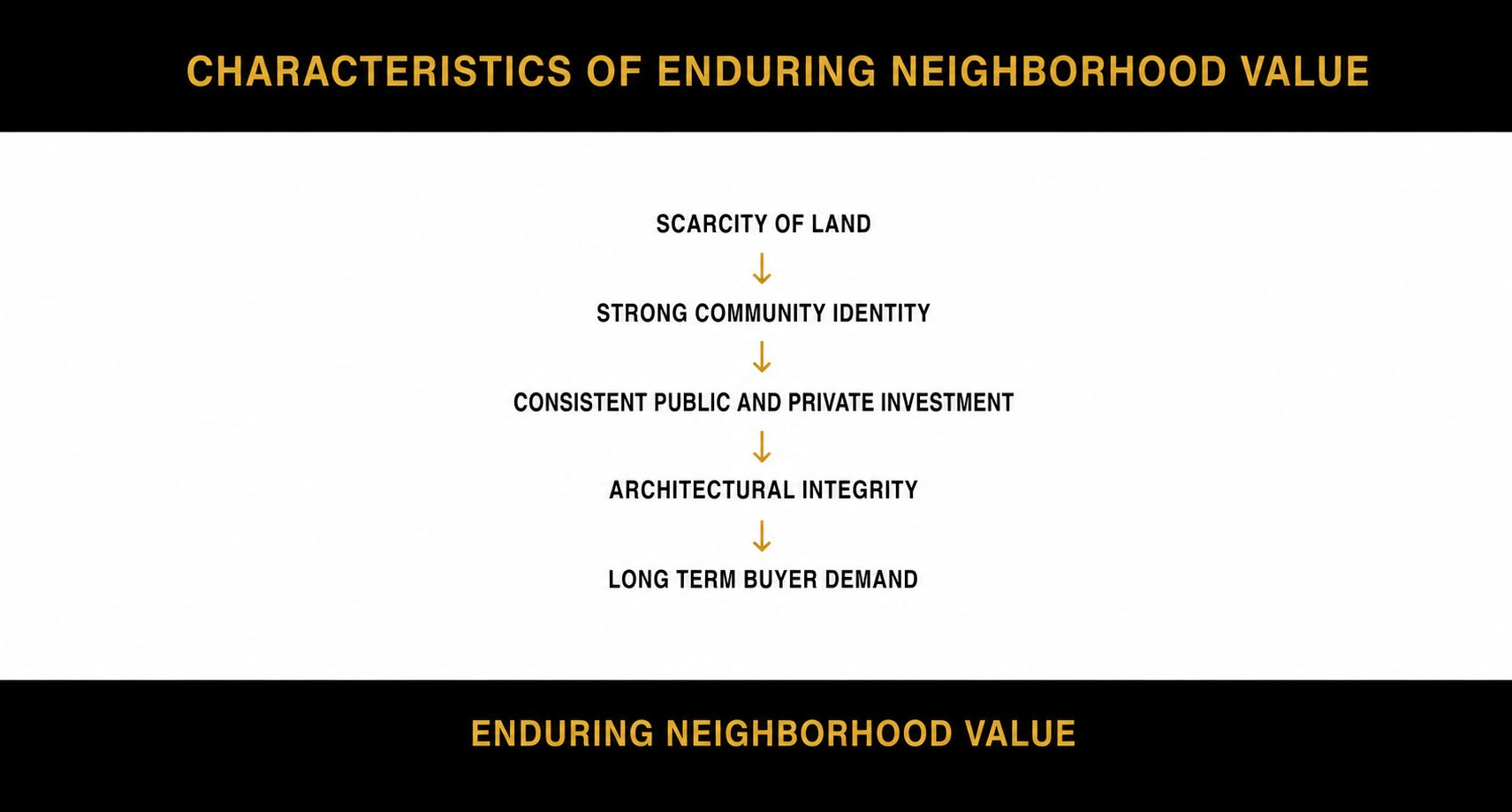
Over time, these individual elements begin reinforcing one another, creating neighborhoods that buyers consistently seek regardless of changing market conditions.
This process helps explain why certain Los Angeles communities have remained desirable for decades despite fluctuations in interest rates, economic cycles, or housing inventory.
The value of a neighborhood is rarely tied to one feature.
Instead, it reflects the combined effect of thousands of decisions made over many years by residents, city planners, business owners, and local governments.
That accumulated investment creates something difficult to duplicate.
A sense of place.
This is one reason buyers often return to the same neighborhoods repeatedly, even when they consider different homes.
They’re not simply purchasing an address.
They’re investing in an established environment whose qualities have been built gradually over time.
Why Great Neighborhoods Become More Valuable Over Time
One characteristic stands out among Los Angeles’ most sought-after communities.
They continue improving even after they’ve become established.
Beverly Hills strengthens its international reputation through luxury retail, hospitality, and cultural events.
Santa Monica continues investing in its beachfront amenities, parks, pedestrian districts, and commercial corridors.
Brentwood preserves its village atmosphere while attracting new restaurants and boutique businesses.
Pacific Palisades continues rebuilding and reinvesting in its community, demonstrating the long-term resilience that has attracted generations of homeowners.
Malibu’s coastline remains one of California’s most irreplaceable natural assets.
Bel Air continues protecting the privacy and low-density character that define its identity.
None of these advantages developed overnight.
They represent decades of careful planning, investment, and community stewardship.
For buyers thinking beyond today’s market cycle, that history often matters just as much as the home itself.
Layer 3: The Home Is Where Owners Create Value
The first two layers of property value – land and neighborhood – are largely fixed. Once you’ve chosen a location, you can’t move the lot or redesign the surrounding community.
The home itself is different.
It is the one layer where thoughtful decisions can significantly enhance value.
This is why two neighboring properties on similar lots can command very different prices.
The difference often isn’t the address. It’s the execution.
Architecture, floor plan, natural light, construction quality, craftsmanship, functionality, and maintenance all shape how buyers perceive a property. These elements influence not only market value but also how quickly a home sells and how strongly buyers compete for it.
A successful renovation isn’t about making a home look expensive.
It’s about making it feel timeless.
Luxury buyers consistently respond to homes that balance aesthetics with functionality. Spaces should feel comfortable rather than oversized, elegant rather than extravagant, and practical enough to support everyday living.
The highest-performing luxury homes rarely follow short-term design trends. Instead, they emphasize enduring principles such as proportion, quality materials, natural light, and thoughtful flow between rooms.
That is one reason some homes continue attracting buyers years after construction while others begin to feel dated surprisingly quickly.
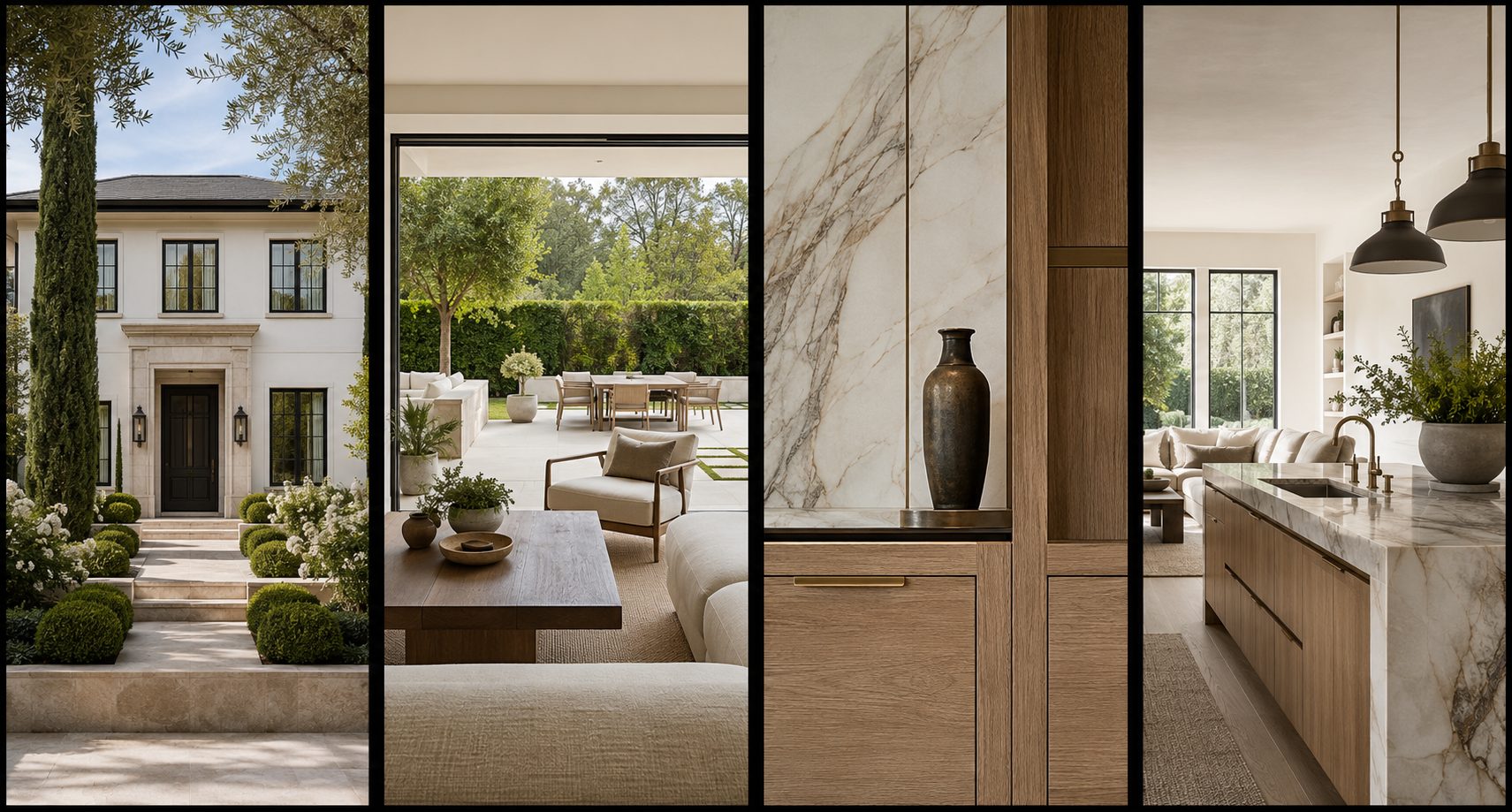
Timeless Design Creates Lasting Value
- Contemporary architecture with clean lines
- Seamless indoor-outdoor living
- Classic traditional architecture with modern updates
- Exceptional craftsmanship and natural materials
Key Insight
Great design ages gracefully.
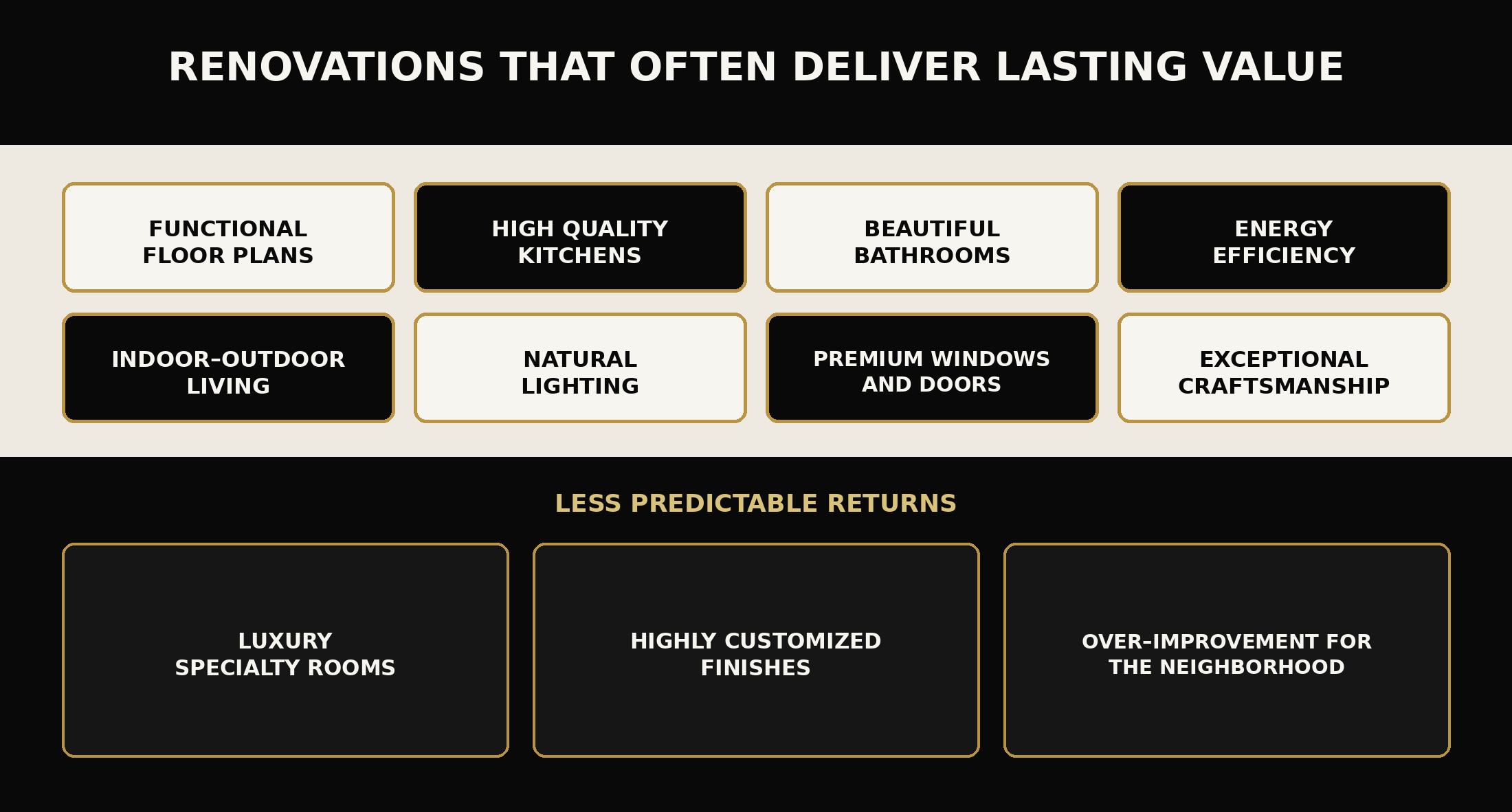
Renovating With Return in Mind
One of the most common questions homeowners ask is:
“Which improvements add the most value?”
The answer depends on the property.
Not every renovation produces a meaningful return.
Some improvements simply personalize a home without increasing what future buyers are willing to pay.
The most successful renovations usually strengthen what already makes the property desirable.
For example:
A beautifully designed kitchen may improve a home’s functionality, but it won’t transform an average location into a premier one.
Likewise, an expensive remodel cannot compensate for poor natural light, awkward floor plans, or an undesirable setting.
Before beginning a renovation, I encourage homeowners to ask several questions:
- Will this improvement appeal to future buyers?
- Does it complement the architecture?
- Is it consistent with surrounding properties?
- Will it remain attractive ten years from now?
When improvements respect both the home and its neighborhood, they often generate stronger long-term returns than projects driven primarily by current design trends.
Layer 4: Market Timing Influences Value, But It Doesn’t Define It
The fourth layer is also the one that receives the most attention.
Interest rates.
Housing inventory.
Economic news.
Consumer confidence.
Election cycles.
Financial markets.
These factors certainly affect real estate activity, and they often dominate headlines.
Yet they are also the most temporary layer.
Markets rise.
Markets slow.
Inventory expands.
Inventory contracts.
Mortgage rates fluctuate.
Buyer sentiment changes.
Throughout these cycles, many people become convinced that waiting just a little longer will produce the perfect opportunity.
Sometimes they’re right.
More often, they discover that the market changed in ways nobody predicted.
One of the lessons I’ve learned over the years is that long-term success in real estate rarely comes from perfectly timing the market.
It comes from purchasing an exceptional property in an exceptional location and allowing time to work in your favor.
Great Properties Continue Creating Demand
Market conditions influence negotiation.
They influence pricing strategies.
They influence marketing.
What they rarely change is the fundamental appeal of exceptional real estate.
Buyers continue searching for outstanding homes in Beverly Hills.
Families continue relocating to Brentwood.
Professionals continue appreciating Santa Monica’s blend of coastal living and urban convenience.
Estate buyers continue valuing Bel Air’s privacy.
Homeowners continue seeking Pacific Palisades for its community character and rebuilding momentum.
Oceanfront properties in Malibu remain among the most limited residential opportunities anywhere in California.
The market may determine when people purchase.
The first three layers largely determine what they continue wanting to own.
That distinction explains why truly exceptional properties often remain desirable across multiple economic cycles.
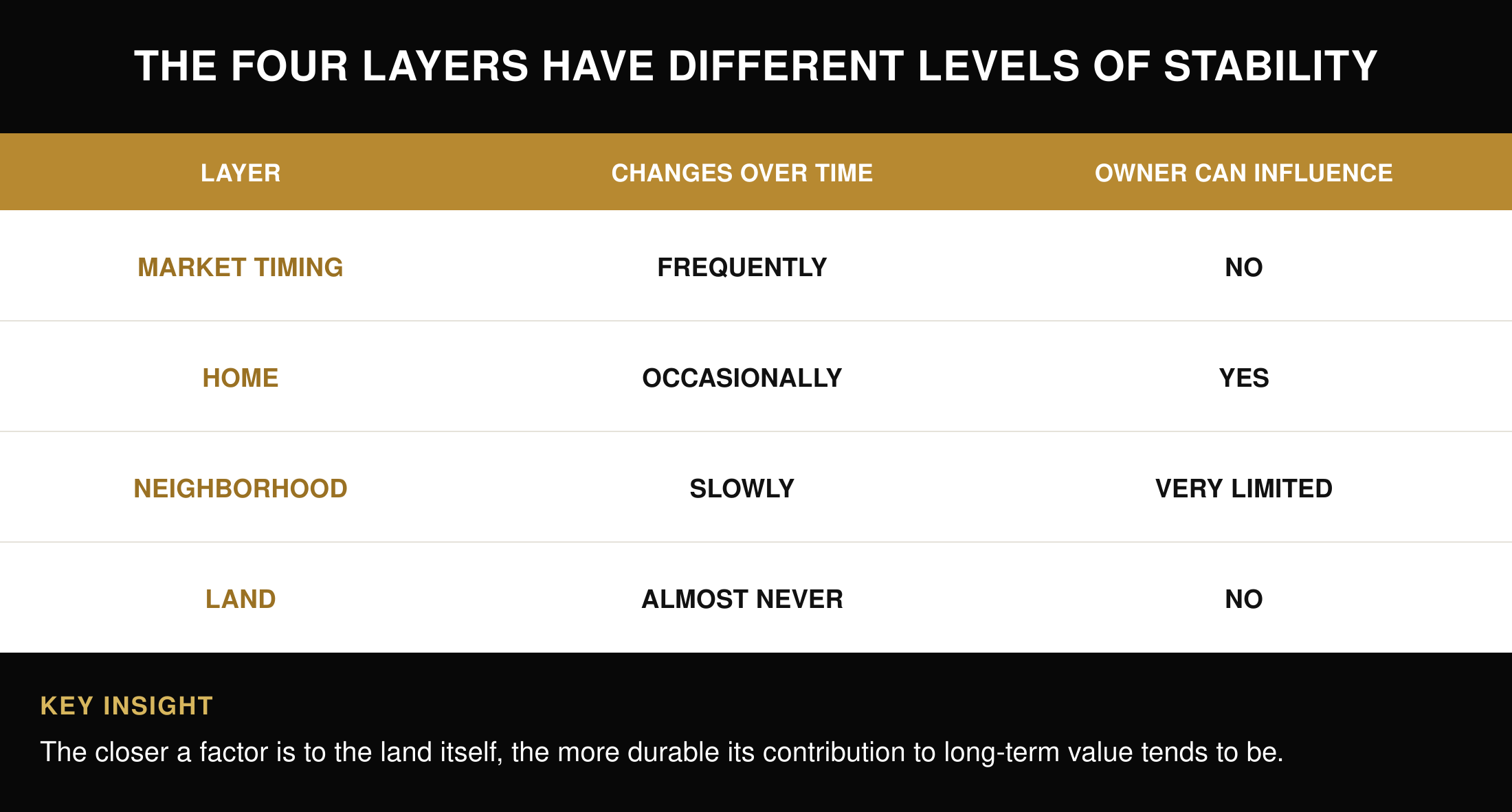
A Different Way to Evaluate Real Estate
One exercise I often encourage buyers to try is surprisingly simple.
Instead of asking:
“Do I love this house?”
Ask four separate questions.
How rare is the land?
How strong is the neighborhood?
How well does the home support long-term living?
Does today’s market provide a favorable opportunity to purchase?
When viewed through those four lenses, the decision often becomes much clearer.
A beautiful home in an average location may not perform as well over time as an attractive home on exceptional land within a highly desirable neighborhood.
Likewise, a temporary shift in interest rates may create a buying opportunity, but it doesn’t fundamentally alter the qualities that have made premier Los Angeles neighborhoods desirable for generations.
Understanding which factors are permanent and which are temporary helps buyers make more confident decisions and helps sellers better understand the strengths of the property they are bringing to market.
Why the Four Layers Matter More in Today’s Market
One of the most valuable characteristics of today’s Los Angeles luxury market isn’t simply pricing.
It’s perspective.
Compared with the highly competitive conditions seen several years ago, buyers generally have more opportunities to evaluate properties carefully, compare neighborhoods, and make thoughtful decisions before writing an offer. That shift allows buyers to focus on long-term fundamentals instead of reacting to intense competition.
Ironically, this type of market often rewards disciplined decision-making.
Instead of asking, “How quickly do I need to act?”, buyers can spend more time asking questions that may have a much greater impact over the next twenty years.
Is the land truly irreplaceable?
Does the neighborhood continue attracting investment?
Will the home’s architecture remain desirable over time?
Am I purchasing because the property is exceptional, or simply because current market conditions appear favorable?
Those questions often produce better decisions than attempting to predict where mortgage rates or home prices might be six months from now.
What This Framework Means for Buyers
Buying luxury real estate is rarely just about acquiring a beautiful home.
It’s about selecting an asset that will continue serving your lifestyle while preserving long-term desirability.
When buyers evaluate all four layers independently, priorities often become clearer.
If a home sits on an extraordinary lot within a highly desirable neighborhood, temporary cosmetic shortcomings may become opportunities rather than obstacles.
Conversely, even an impeccably renovated home may struggle to match the long-term appeal of a superior location if the underlying land or neighborhood lacks the same enduring characteristics.
That perspective often changes the way buyers compare properties.
Instead of concentrating primarily on finishes, they begin asking broader questions about permanence, scarcity, and future demand.
Those conversations frequently lead to more confident purchasing decisions.
What This Framework Means for Sellers
For homeowners preparing to sell, the Four Layers of Property Value provide a useful way to position a property before it reaches the market.
Every seller naturally focuses on the home itself.
Fresh paint.
Professional staging.
Landscape improvements.
Updated lighting.
Photography.
Marketing.
Those details remain important because they influence first impressions.
However, the strongest marketing also highlights the property’s first two layers.
The quality of the land.
The strength of the neighborhood.
Those characteristics cannot be replicated by competing listings.
A beautifully prepared home attracts attention.
An exceptional location creates lasting demand.
The most effective marketing strategy communicates both.
Rather than simply listing features, successful luxury marketing tells buyers why the property occupies a location that will remain desirable for years to come.
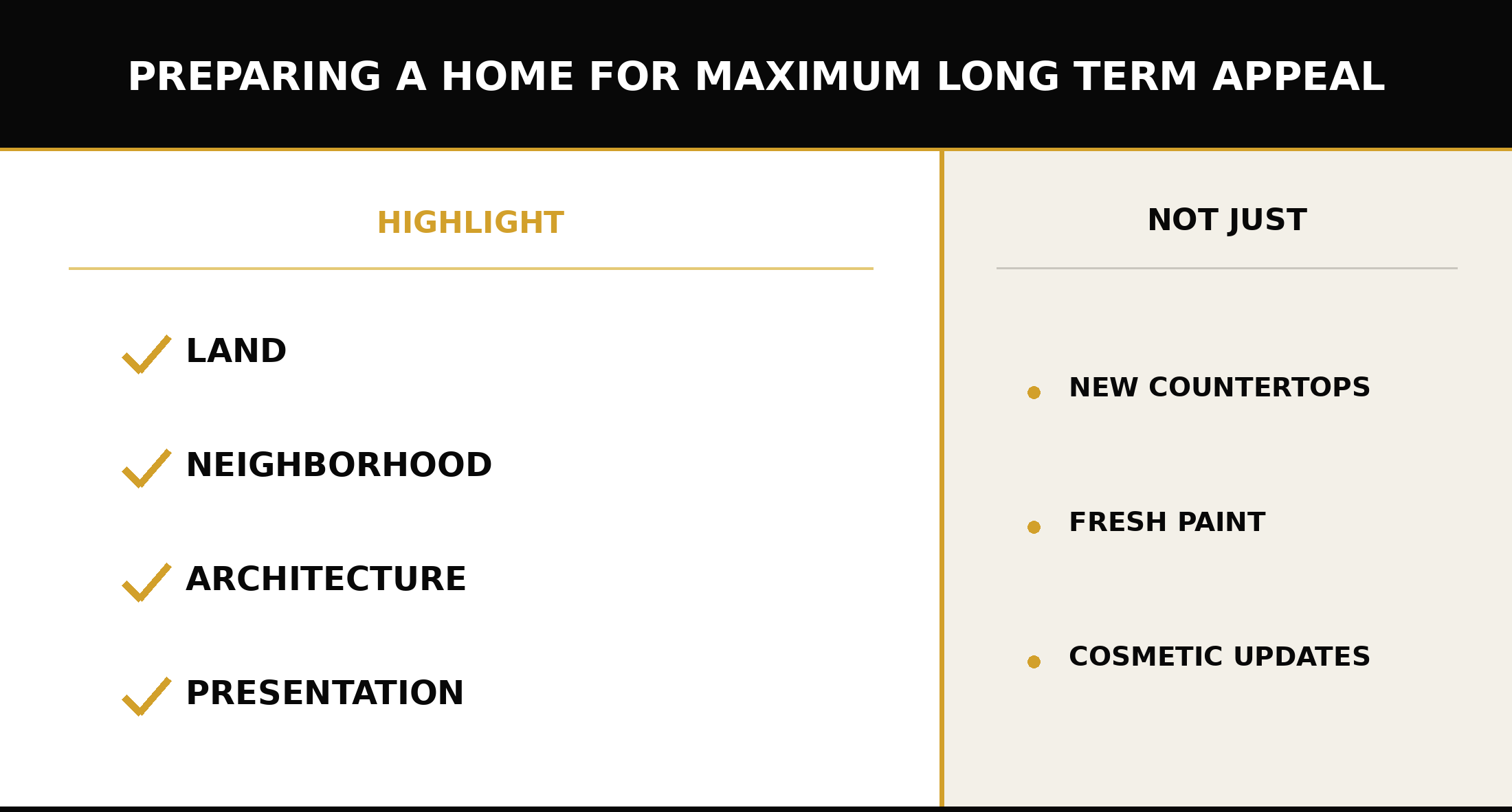
Looking Beyond Today’s Headlines
Real estate headlines often focus on short-term events.
Interest rates.
Economic forecasts.
Election cycles.
Inventory changes.
While those developments deserve attention, they represent only one of the four layers influencing a property’s long-term value.
The strongest real estate decisions are usually grounded in factors that change very slowly.
Exceptional land remains exceptional.
Well-established neighborhoods continue attracting new generations of buyers.
Thoughtful architecture endures.
Only market timing shifts from year to year.
Keeping that perspective helps buyers avoid reacting emotionally to temporary conditions while helping sellers recognize the enduring strengths their properties already possess.
Conclusion
Luxury real estate has always been about more than beautiful homes.
The properties that continue performing well over decades often share something much deeper.
They occupy exceptional land.
They belong to enduring neighborhoods.
They feature homes designed to stand the test of time.
And eventually, they benefit from favorable market conditions.
Understanding these four layers doesn’t eliminate uncertainty.
Real estate will always involve changing markets and evolving buyer preferences.
But it does provide a framework for separating temporary conditions from lasting value.
Whether you’re purchasing your first luxury residence, selling a longtime family home, or expanding a real estate portfolio, asking the right questions often matters more than finding the perfect market forecast.
Because while no one can consistently predict the next market cycle, buyers and sellers can still recognize the qualities that have made Los Angeles’ premier neighborhoods desirable for generations.
And in my experience, those qualities continue to matter long after today’s headlines have faded.
Key Takeaways
The Four Layers of Property Value
- Land provides the foundation of long-term scarcity.
- Neighborhood compounds value through decades of investment and reputation.
- The Home is where thoughtful design and craftsmanship create additional value.
- Market Timing influences opportunity but should rarely outweigh the first three layers.
Understanding these layers helps explain why certain properties continue attracting buyers through changing economic conditions and why exceptional real estate remains exceptional regardless of the current news cycle.
